Why aren't plastic toothbrushes banned in Australia?
Because, as far as we can find, no government has tried. Bans like NSW’s target single-use items that are among the most littered and have ready alternatives, like bags, straws and cutlery. A toothbrush is meant to last months, and most bamboo brushes still have plastic bristles. So the plastic item you put in your mouth twice a day sits outside every ban we found.
Written by Reuben S., who runs BARE and packs every order. Published 12 October 2026
What’s actually banned
Plastic bans in Australia are run by the states and territories, not the federal government. A national list of 24 predominantly single-use items that environment ministers agreed to work on together includes lightweight bags, straws, cutlery, plates and plastic-stemmed cotton buds. Toothbrushes aren’t on it. NSW, for example, banned lightweight plastic bags from June 2022 and plastic straws, cutlery, plates and cotton buds from November 2022, including versions made from compostable or bio-based plastic.
It isn’t uniform, though. As at August 2026, Tasmania’s statewide phase-out was waiting on legislation to pass Parliament, so a plastic straw isn’t banned everywhere in Australia either.
How those items were chosen
Two tests come up in NSW and EU law: is the item littered a lot, and is there an easy alternative? NSW chose the most littered plastic items, which it says are littered at about 20 times the rate of other plastics. In picking them it considered the availability of sustainable alternatives and the cost of switching, and set some items aside for review until alternatives were more widely available. The EU’s law works the same way: it covers the single-use plastics found most on beaches, and bans those with affordable alternatives readily available.
The items are also meant to be single-use. South Australia describes them as used once or a limited number of times, often away from home, and thrown away after brief use, usually ending up as litter.
Why toothbrushes don’t fit
No regulator has said why toothbrushes aren’t on the lists, so this is our reading of those criteria.
- It isn’t a one-use item. The Australian Dental Association recommends brushing twice a day for two minutes and replacing the brush every three months. That’s around 180 uses, by our arithmetic, not one.
- It’s used and thrown out at home. The bans go after things used briefly away from home and dropped, like straws and cutlery. With a toothbrush, the Australian Dental Association says most toothbrushes can’t go in the home recycling bin, so they go in the rubbish. Toothbrushes do turn up as litter, though: a 2019 survey of the remote Cocos (Keeling) Islands estimated 373,000 toothbrushes on their beaches; the study doesn’t say where they came from.
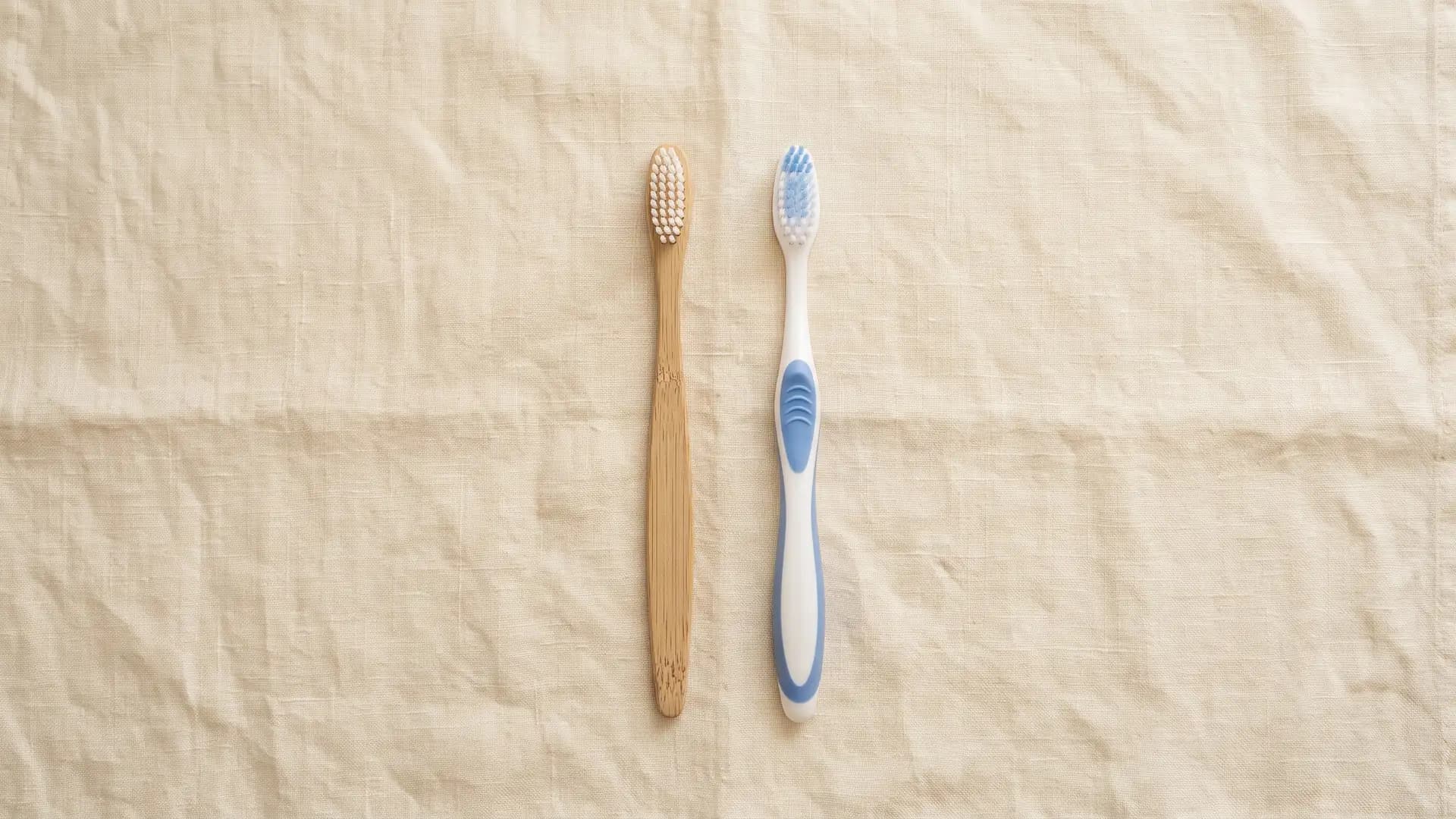
- The usual alternative is still plastic. Most bamboo toothbrushes have nylon bristles, so a ban on plastic toothbrushes would likely catch most of the brushes sold as the eco option too.
- Regulators tread carefully around health. Even for banned items, Victoria made exceptions for health and safety reasons, such as straws for people who need them for a disability or medical reason. A toothbrush is a daily hygiene item, which would make any ban harder to design.
The plastic you put in your mouth
Here’s the odd part. A plastic straw might touch your lips for a few minutes. A plastic toothbrush is scrubbed around your mouth for two minutes, twice a day, every day, and its bristles wear down as you use it. Lab studies have found that plastic bristles shed tiny particles as they wear: one preliminary 2025 study, brushing a model set of teeth, measured up to about 39 particles a day from the commercial brushes it tested.
What that means for the person brushing hasn’t been measured. Those are release figures, not what’s swallowed: a 2026 review for the Australian Centre for Disease Control notes that many particles are spat out, and that the studies it reviewed gave no data on how many are swallowed. The Australian Dental Association told a Senate inquiry in March 2026 that toothbrushes can release particles but that current evidence does not establish clear clinical risk, and asked for more research. In the same inquiry, Food Standards Australia New Zealand said the evidence does not indicate a public health concern from microplastics in food at current levels, calling them an emerging issue rather than an established food safety risk, while pointing to big gaps in the science. The committee’s May 2026 report said that, with evidence still emerging, inquiry participants agreed on a precautionary approach to microplastics generally, not toothbrushes in particular.
So no health authority says plastic toothbrushes have been shown to cause harm, and the evidence is still too thin to rule it out. What’s certain is what the bristles are made of. More on the research in do toothbrushes shed microplastics?
Is a ban coming?
Not that we can find. NSW’s next round of phase-outs covers things like pizza savers, bread tags and foam food trays, with no toothbrushes. Queensland says further single-use plastic bans are not planned at this time. If you want a toothbrush without plastic bristles, it’s up to you, not the rules (as at October 2026).
What you can do
- Check the bristles, not just the handle. A bamboo handle with nylon bristles is still a plastic toothbrush where it touches your teeth. Our guide to choosing a plastic-free toothbrush shows what to look for.
- Keep brushing properly. Whatever brush you use, twice a day for two minutes is the advice.
- Dispose of it properly. See can you recycle a plastic toothbrush?
Where we fit
We made a toothbrush whose bristles aren’t plastic at all: sterilised horse hair woven into a bamboo head, with no nylon and no glue. There’s one small aluminium staple inside the head, and horse hair isn’t vegan. We don’t claim it’s better for your health; nobody has studied that. We just think the thing you put in your mouth twice a day is worth a second look, whether or not the rules ever get to it.
The short version
- No Australian state or territory bans plastic toothbrushes, and we found no government that has proposed it (as at October 2026).
- Bans target single-use, heavily littered items with ready alternatives.
- Toothbrushes are meant to last months and are used at home, and most bamboo brushes still have nylon bristles.
- Plastic bristles shed particles; what that means for health hasn’t been measured.
Common questions
01Are plastic toothbrushes banned in Australia?
No. As at October 2026, no Australian state or territory bans plastic toothbrushes, and they are not on the national list of 24 predominantly single-use plastic items that environment ministers agreed to work on together. We found no government in Australia or overseas that has proposed banning them.
02Why are plastic straws banned but not toothbrushes?
Plastic straws are banned in NSW, Queensland and Victoria, among others, though not everywhere: as at August 2026 Tasmania had not yet passed its law. Bans like NSW's target the most littered single-use plastics with ready alternatives, and the EU picked the single-use items found most on beaches where affordable alternatives exist. Dental advice is to brush twice a day and replace the brush every three months, and most bamboo toothbrushes still have nylon bristles. No regulator has said why toothbrushes aren't on the lists; that is our reading of the criteria.
03Do plastic toothbrushes shed microplastics?
Lab studies have found that plastic bristles shed tiny particles as they wear; one preliminary 2025 study measured up to about 39 a day from the commercial brushes it tested on a model set of teeth. Those are release figures, not what is swallowed: a 2026 review for the Australian Centre for Disease Control notes many particles are spat out and that the studies it reviewed gave no data on how many are ingested. In March 2026 the Australian Dental Association told a Senate inquiry that current evidence does not establish clear clinical risk.
04Will plastic toothbrushes be banned in the future?
Nothing we found suggests it. As at October 2026, NSW's next round of phase-outs does not include toothbrushes and Queensland says no further single-use plastic bans are planned; as at August 2026, Tasmania had not yet passed its first single-use plastics law. In May 2026 a Senate committee said inquiry participants agreed on a precautionary approach to microplastics generally, without singling out toothbrushes.
Sources
- Harmonising action on problematic and unnecessary plastics. Australian Government, Department of Climate Change, Energy, the Environment and Water, 2025. Checked .
- Plastics bans guidance. NSW Environment Protection Authority, 2025. Checked .
- Single-use plastics: frequently asked questions. Department of Natural Resources and Environment Tasmania, 2026. Checked .
- About the plastics bans. NSW Environment Protection Authority, 2025. Checked .
- NSW Plastics Action Plan. NSW Department of Planning, Industry and Environment, 2021. Checked .
- Directive (EU) 2019/904 on the reduction of the impact of certain plastic products on the environment. European Parliament and Council of the European Union, 2019. Checked .
- Legislation explained. Green Industries SA (Government of South Australia). Checked .
- Brushing teeth. Australian Dental Association. Checked .
- Sustainable oral health care. Australian Dental Association. Checked .
- Significant plastic accumulation on the Cocos (Keeling) Islands, Australia. Scientific Reports, 2019. DOI 10.1038/s41598-019-43375-4. Checked .
- Exploring Sustainable Alternatives for Toothbrushes. Plastics Engineering (Society of Plastics Engineers), 2024. Checked .
- Single-use plastics. Environment Protection Authority Victoria, 2025. Checked .
- Preliminary results on microplastic release from commercial toothbrushes during simulated brushing. Microchemical Journal, 2025. DOI 10.1016/j.microc.2025.114680. Checked .
- Microplastics and health: evidence review. Allen + Clarke for the Australian Centre for Disease Control, 2026. Checked .
- Submission 42 to the Senate inquiry into the impact of microplastics and other toxics on human health. Australian Dental Association, 2026. Checked .
- Submission 10 to the Senate inquiry into the impact of microplastics and other toxics on human health. Food Standards Australia New Zealand, 2026. Checked .
- Impact of microplastics and other toxics on human health: committee view. Parliament of Australia, Senate Community Affairs References Committee, 2026. Checked .
- NSW Plastics Plan 2.0. NSW Environment Protection Authority, 2026. Checked .
- Banned single-use plastic items. Queensland Government, 2026. Checked .
Sources were checked between 3 and 12 October 2026: Australian federal, state and territory governments, the EU, the Parliament of Australia, FSANZ, the Australian Dental Association and peer-reviewed research. Plastic rules change, so check your state. This page is general information, not health advice.