Are bamboo toothbrush bristles plastic?
Yes, almost always. Nylon, a plastic, is the most widely used toothbrush bristle material, and a bamboo handle changes nothing about that. The handle is the part everyone photographs; the bristles are the part that decides whether the brush is actually plastic-free, and they are the part the packaging tends to be quietest about.
Written by Reuben S., who runs BARE and packs every order. Published 11 August 2026
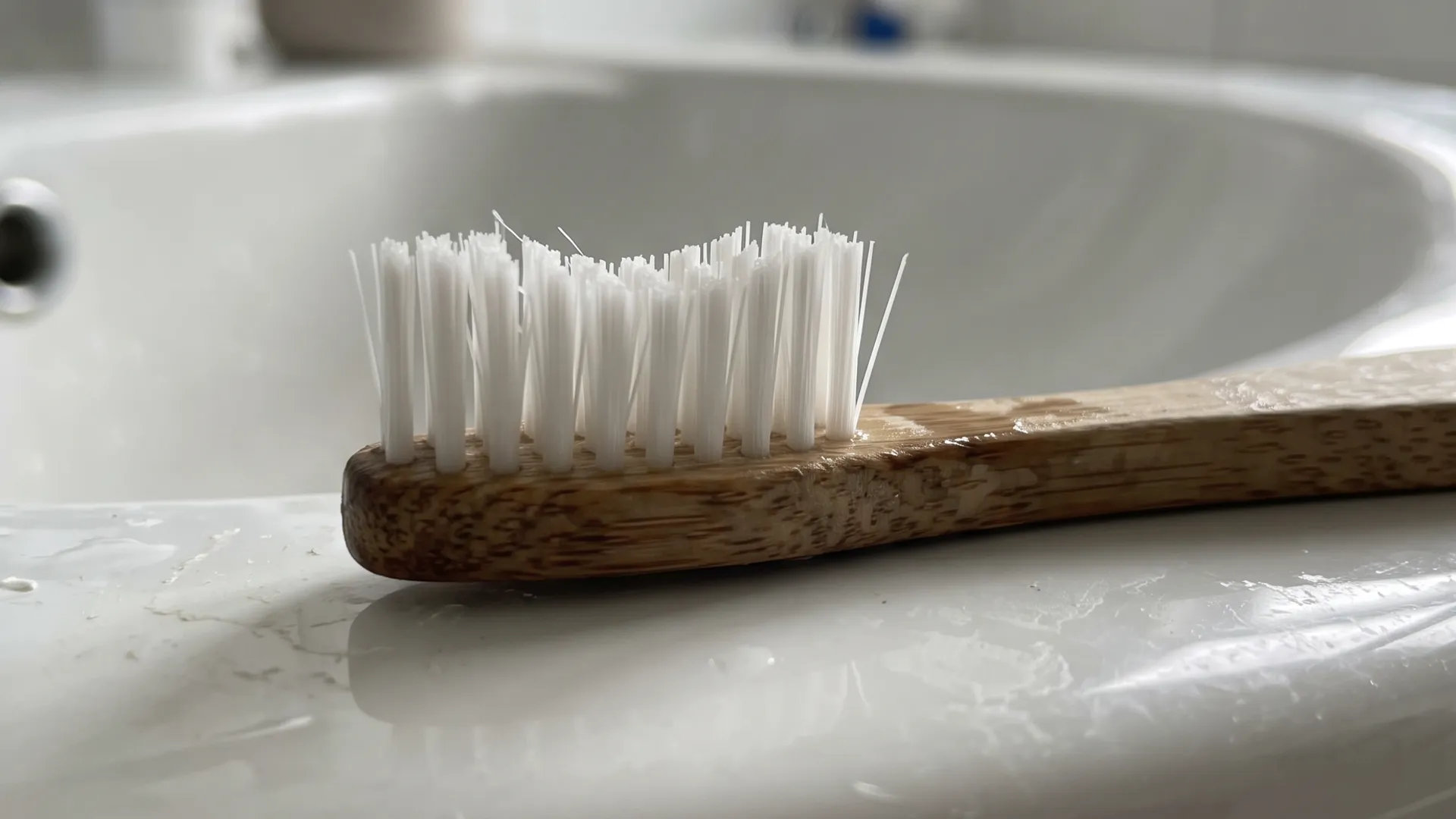
What bristles are actually made of
Most toothbrush bristles are extruded nylon: a 2024 dental study of filament materials calls it the most widely used material for bristles, and a trade review of eco brushes found it is the most common choice for bamboo toothbrushes too. Manufacturers’ own patents list the usual filaments as nylon 6,6, 6,10 or 6,12, or PBT or PET polyester. All of those are plastics. Typical bristle monofilament runs about 0.15 to 0.18 mm across, drawn to length and cut.
None of that changes when the handle is bamboo. A bamboo toothbrush is, in the overwhelming majority of cases, a wooden stick with a small piece of permanent plastic set into one end.
The nylon-4 question, properly
A handful of brands market bristles made from nylon-4 (polyamide 4) as biodegradable. This is where most articles either repeat the claim or dismiss it, and neither is right.
The research is real. Published work has measured polyamide 4 breaking down in seawater — laboratory tests showed roughly 30% degradation in four weeks, and films placed in actual sea environments lost between 10 and 70% of their weight over six weeks. Soil studies have identified PA4-degrading bacteria and enzymes, with one reporting around 65% degradation in fifteen days. That is not nothing, and anyone waving the claim away is overstating their case.
But look at what was tested. Those studies used thin PA4 films, not drawn bristle monofilament. The researchers themselves note that swelling behaviour and the polymer’s crystal structure strongly affect how fast it degrades — and a bristle is about as far from a thin film as the same polymer gets: thicker, drawn under tension, and far more crystalline as a result. A rate measured on film does not transfer to a bristle.
And most of it ends up somewhere else entirely. Seawater and active soil are not landfill, which is where the majority of toothbrushes go, and which is dark, dry and largely anaerobic.
The largest catch is simpler. Nylon-4 isn’t what is in almost any toothbrush. The usual bristle nylons are types like 6,6, 6,10 and 6,12, and nobody claims those biodegrade. So unless a brush specifically says nylon-4, the research above has nothing to do with the brush in your hand.
If a brush does say nylon-4, the honest position is that it’s a genuinely more interesting material with real science behind it, and that nobody can currently tell you what a nylon-4 bristle does in your compost bin. That is a reasonable thing to ask a brand. “Biodegradable” on a box is not an answer to it.
“BPA-free” is not the same thing
You will see this on packaging and it is doing rhetorical work rather than informative work. BPA is one particular compound used in some plastics. A product can be completely free of it and still be plastic. BPA-free tells you about the chemistry of the plastic, not about whether there is any.
What isn’t plastic
Natural animal fibre. Boar bristle was the standard for centuries, and horse hair is the finer, more flexible version of the same idea. Both are keratin — the protein family that also makes wool and human hair — so they break down the way other animal fibres do rather than persisting.
We should be straight that this is what we make and sell, and that it carries its own costs: it isn’t vegan, and it takes longer to dry. We wrote those up in horse hair toothbrush bristles, explained, including the parts that don’t suit us.
How to check any brush before you buy it
This is the useful part even if you never buy anything from us.
- Look for the bristle material, not the handle. “Bamboo toothbrush” describes a handle. It is not a statement about the head.
- Nylon, nylon-6, nylon-6,6, polyamide, PBT — all plastic. The word “polyamide” is simply nylon in a lab coat.
- If the material isn’t stated, assume nylon. A brand using anything else almost always says so, because it is the more marketable claim. Silence is information.
- Read “biodegradable” for what it omits. If it says the handle is biodegradable, it is telling you about the handle.
- Check what disposal actually requires. If the honest instruction is “remove the bristles with pliers”, the bristles are plastic. We cover that in how to dispose of a bamboo toothbrush.
The short version
- Nylon is the most widely used bristle material. Bamboo handles included.
- Nylon-4 biodegradation research is real, but it tested films rather than bristles — and nylon-4 is not what nearly any brush uses.
- BPA-free does not mean plastic-free.
- Natural animal fibre is the non-plastic option, with its own trade-offs.
Common questions
01Are bamboo toothbrush bristles plastic?
Almost always yes. Nylon is the most widely used bristle material, and it is the most common choice on bamboo-handled brushes as well as plastic ones. The usual types are nylon 6,6, 6,10 or 6,12, and some brushes use PBT polyester instead. All of them are plastics. The handle material tells you nothing about the bristles.
02Is nylon-4 really biodegradable?
Polyamide 4 does biodegrade in published research, but the studies were carried out on thin PA4 films in seawater, soil and laboratory conditions, not on drawn bristle monofilament, and the material's crystal structure strongly affects how fast it breaks down. Separately, nylon-4 is not what almost any toothbrush uses — the standard bristle materials are nylon 6 and 6,6, for which no such biodegradation is claimed. Treat a nylon-4 claim as a question to ask, not an answer.
03Does BPA-free mean a toothbrush is plastic-free?
No. BPA is one specific compound used in some plastics. A brush can be entirely free of it and still be made of plastic. BPA-free tells you something about the chemistry of the plastic, not about whether there is plastic.
04What toothbrush bristles are not plastic?
Natural animal fibre — boar bristle, or horse hair — is not plastic. Those are keratin, the protein family that also makes up wool and human hair, and they break down like other animal fibres. They are a small part of the market, they are not vegan, and they take longer to dry than nylon.
05How can I tell what my toothbrush's bristles are made of?
Check the packaging or the brand's website for the bristle material specifically, not the handle. If it says nylon, nylon-6, nylon-6,6 or polyamide, it is plastic. If it says nothing at all, assume nylon — brands using anything else tend to say so, because it is the more marketable claim.
Bristle materials are described at category level here, from published sources on toothbrush filament and polyamide biodegradation. Individual products vary — check the specific brush.