Do toothbrushes shed microplastics?
Yes. Nylon bristles wear down with brushing, and the worn material leaves as microscopic fragments — the few studies that have measured it found on the order of dozens of particles a day. Two honest caveats belong next to that: the research is new and small, and nobody yet knows what ingesting those particles means for health.
Written by Reuben S., who runs BARE and packs every order. Published 14 August 2026 · Last fact-checked 25 August 2026
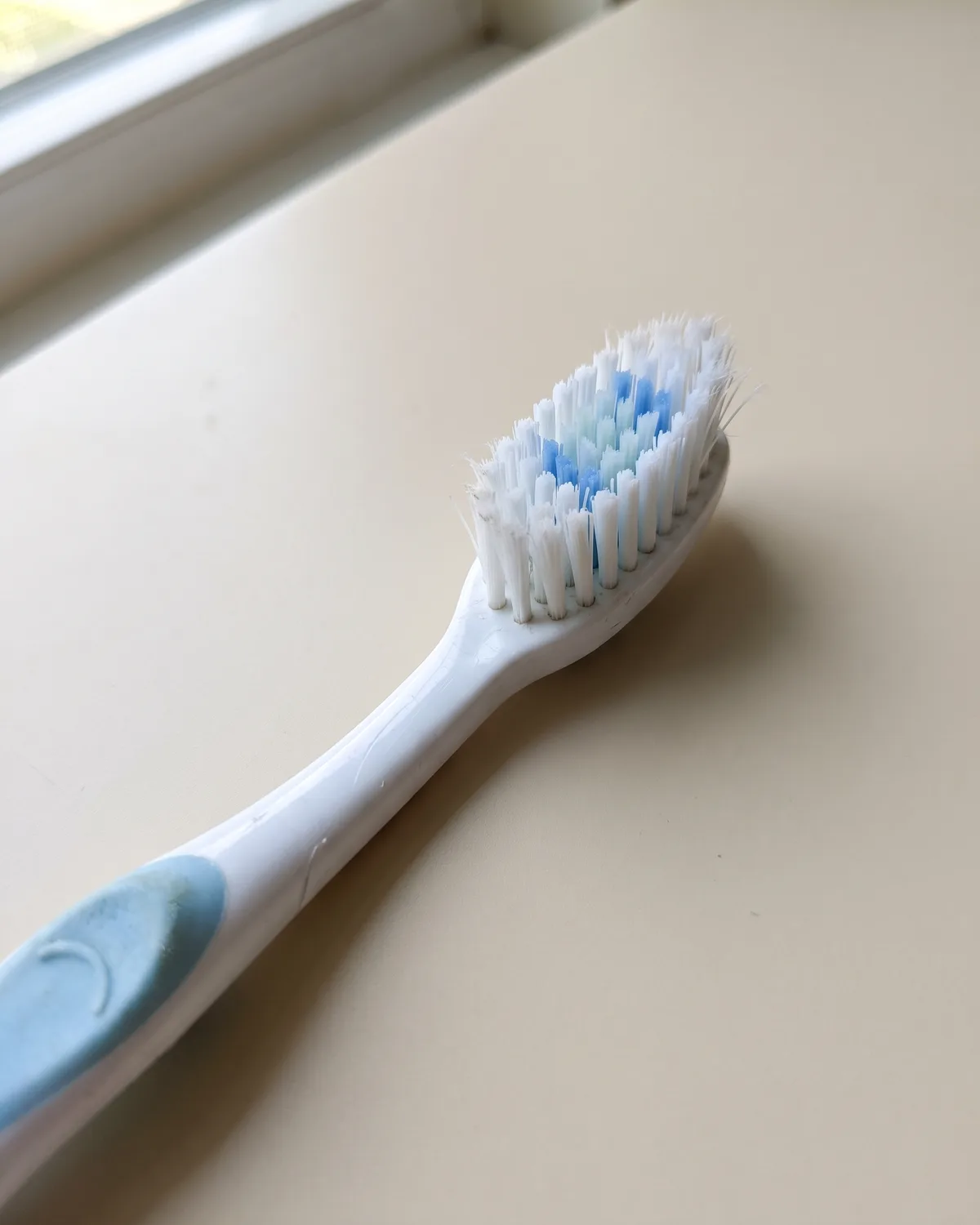
The mechanism is not in dispute
Look at a brush you’ve used for three months: the bristle tips have gone from smooth and rounded to frayed and fuzzy, and the head as a whole has visibly less crisp material than it started with. That missing material went somewhere. Brushing is deliberate abrasion — filament against enamel, twice a day, with paste that is itself mildly abrasive — and abrasion of a plastic filament produces plastic fragments. Some are rinsed down the drain; some are in your mouth when you spit.
This is the same wear that makes dentists tell you to replace a brush every three months. The splaying you can see and the shedding you can’t are one process.
What the studies have actually measured
The measurement research is genuinely young — the main results arrived in the last few years, and there aren’t many of them. The two worth knowing:
- A 2023 study in Environmental Pollution used Raman imaging to identify particles released from toothbrushes, confirming that bristle-derived fragments can be detected and typed — largely a proof of method.
- A 2025 study in Microchemical Journal — titled “Preliminary results” by its own authors, which we’re keeping attached — simulated brushing on a dental arch with commercial brushes and measured an average release of up to roughly 39 microplastic particles a day, identified as nylon and PBT, in fragment and fibre form. Cheaper brushes shed more.
You may meet larger figures elsewhere — a claim of 120 particles per brushing session circulates widely on eco-brand blogs. We went looking for its primary source and couldn’t find one we could check, so we’re not using it. Dozens a day, from a small preliminary literature, is what the checkable evidence currently supports.
What nobody knows yet
Here is the part an honest page has to say plainly: no study has linked toothbrush microplastics to any health outcome. Microplastics have been found in human blood and tissue in the broader literature, and researchers are actively working on what that means — but “detected” and “shown to cause harm” are different findings, and for ingested microplastics generally the second one doesn’t exist yet, in either direction.
So we won’t tell you your toothbrush is hurting you. We sell the alternative, and a scare dressed as science would be the cheapest trick available to us. What’s true is narrower: the particles are real, the dose is small-but-daily over a lifetime of brushing, and the question is open. Some people are comfortable with that; some would rather not run the experiment. Both are reasonable readings of the same evidence.
What’s proportionate to do
- Replace on time. Frayed tips are the worn material on its way out — and a splayed brush cleans worse anyway. This is standard dental advice with a microplastic bonus.
- Brush light. Pressure accelerates wear. Light pressure is also, independently, what dentists keep asking people to do — soft brush, light pressure.
- Or remove the mechanism. Bristles that aren’t plastic can’t shed plastic. That’s the version we make — the genuinely nylon-free options are few, ours is one, and you can weigh that interest as you read this page.
The short version
- Yes: worn nylon and PBT bristles shed microplastic fragments; brushing is abrasion and the frayed tips are the evidence.
- What the small early studies actually measured: on the order of dozens of particles a day.
- Health effects: unknown, in either direction. Anyone telling you otherwise — reassuring or alarming — is ahead of the evidence.
- Proportionate response: replace on time, brush light, or choose bristles that aren’t plastic.
Common questions
01How many microplastic particles does a toothbrush release?
The honest answer is that only a handful of studies have measured it, and they are recent and small. A 2025 study in Microchemical Journal — titled as preliminary results by its own authors — simulated brushing on a dental arch and measured an average release of up to roughly 39 microplastic particles a day, identified as nylon and PBT from the bristles. Treat the number as an early estimate, not a settled figure.
02Are microplastics from toothbrushes harmful?
Nobody knows yet, and we won't pretend otherwise. Microplastics have been detected in human blood and tissue in general studies, but no research has linked toothbrush-derived particles to any health outcome, and the health effects of ingested microplastics overall are still an open scientific question. If the uncertainty bothers you, that's a reasonable response to genuine uncertainty — but this page can't tell you a risk number that science doesn't have.
03Do electric toothbrush heads shed microplastics too?
The bristles on electric brush heads are the same nylon and PBT filaments used on manual brushes, worn by the same brushing friction — the shedding mechanism doesn't care whether the handle moves itself. The published simulation work has focused on manual brushes, so electric heads are less measured, not known to be different.
04Do bamboo toothbrushes shed microplastics?
If the bristles are nylon — and on nearly every bamboo brush they are — then yes, the same way a plastic-handled brush does. The handle was never the shedding part; the bristles are. A bamboo brush only avoids the mechanism if the bristles themselves aren't plastic, which is rare and worth checking before you buy.
05How do you reduce microplastics from brushing?
Proportionate steps, in order: replace the brush when the bristles splay, because frayed tips are the worn material leaving the brush — this is also just standard dental advice; brush with light pressure, which wears bristles slower and is what dentists recommend anyway; and if you want to remove the mechanism entirely, use a brush whose bristles aren't plastic at all. The first two cost nothing and are worth doing regardless.
Nothing here is health advice, and this page makes no claim that any toothbrush causes or prevents any health condition. The research cited is current as at August 2026; this is a fast-moving literature and we’ll update the page as it grows. For anything about your own health, talk to your doctor or dentist.