Are castor oil toothbrush bristles plastic?
Yes. Castor oil is a raw material, not a fibre. To become a bristle it is turned into a nylon, such as nylon 11, and the result is a polyamide plastic. “Plant-based” tells you where the raw material came from, not what the bristle is, and bio-based is not the same as biodegradable.
Written by Reuben S., who runs BARE and packs every order. Published 4 October 2026
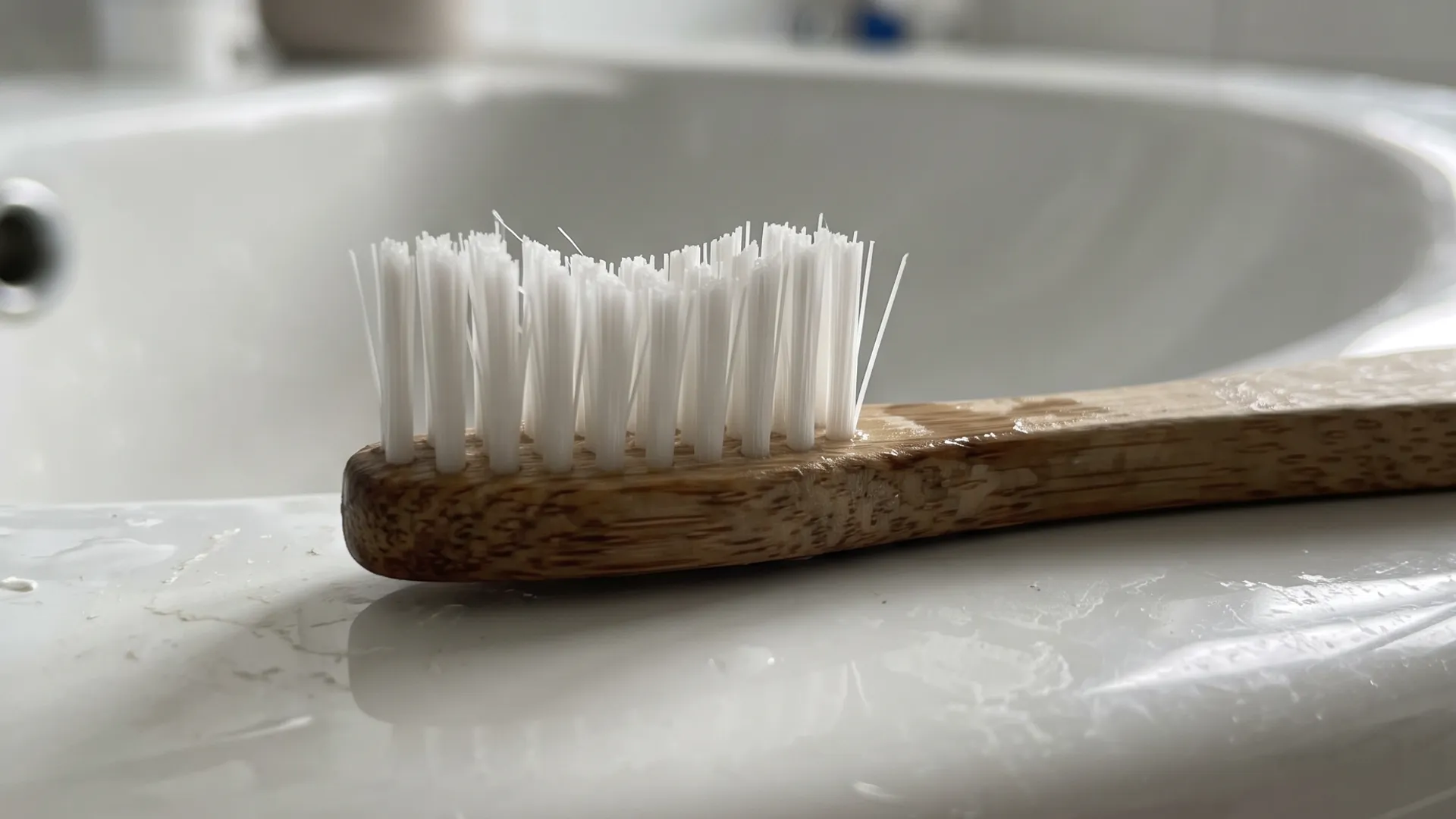
What “castor oil bristles” means
Castor oil is pressed from the seeds of the castor plant. It’s a liquid, so nobody brushes with it directly. Chemists use it as a starting material, and through several steps it becomes nylon 11. When McGill University’s Office for Science and Society looked at a castor-bristle toothbrush, the bristles were nylon 11.
Castor oil also gives sebacic acid, a building block of two more nylons, 610 and 1010. One manufacturer describes its nylon 610 as partly based on renewable resources and its nylon 1010 as entirely so.
So on a toothbrush pack, “castor oil”, “plant-based” and “bio-based” are describing where a nylon’s raw material grew. The bristle in your mouth is still nylon, a plastic, just as it would be if the raw material had come from petroleum.
Three nylons that can be made from castor oil
| Nylon | The castor-based part | Still a plastic? |
|---|---|---|
| Nylon 11 (PA11) | Its building block, 11-aminoundecanoic acid, is made from castor oil | Yes |
| Nylon 610 (PA610, also written 6,10) | One of its two building blocks, sebacic acid, so it can be partly castor-based | Yes |
| Nylon 1010 (PA1010) | Both building blocks, so it can be entirely castor-based | Yes |
Bio-based is not the same as biodegradable
“Bio-based” means a plastic is made fully or partly from biological resources. The European Commission puts the catch plainly: bio-based plastics are not necessarily biodegradable or compostable. Where a plastic’s raw material grew doesn’t decide whether it breaks down.
The bioplastics industry’s own association goes further on nylon. European Bioplastics, which promotes these materials, lists bio-based polyamides among bio-based plastics that are not biodegradable.
On nylon 11 itself, researchers describe it as a synthetic plastic that has previously been considered non-biodegradable. The same 2022 lab study found mealworm larvae can chew nylon 11 film, though they did no better on it than larvae given no food. That’s an interesting early result, and it is a long way from a bristle breaking down in your compost. We couldn’t find a published standard biodegradation test on nylon 11 either way, so we say “not considered biodegradable” rather than “proven not to biodegrade”.
In Australia, the ACCC’s guide to environmental claims uses a toothbrush as one of its examples: a brush made from bio-based plastic, labelled “biodegradable approved” without being tested, is given as a claim likely to be false or misleading. The example is hypothetical and the plastic in it is bio-based PE, not nylon. It shows the same gap this page is about: where a plastic came from and whether it breaks down are separate questions.
What to check on the label
- Castor oil, nylon 11, PA11, polyamide. All of these describe a nylon, so the bristles are plastic. “Plant-based” and “bio-based” only say where the raw material came from, so check what the bristle actually is.
- “Biodegradable” near the bristles. Ask what was tested, and under what conditions. A raw material that grew in a field isn’t an answer to that.
- The disposal instructions. If the pack says to pull the bristles out before composting the handle, the bristles don’t compost. We cover that in how to dispose of a bamboo toothbrush.
- If you want no plastic at all. The bristles need to be a named animal fibre, horse hair or boar bristle. Our nylon-free toothbrush guide goes through what to look for.
Where we fit
We make a horse hair brush, so read this part knowing that. Our bristles are sterilised horse hair woven into the bamboo head, with no nylon of any kind and no glue.
Two honest catches. Ours isn’t vegan, because horse hair is an animal product. And there is one small aluminium staple inside the head, which doesn’t compost, so fish it out at the end. If vegan is your line, a castor-oil brush is a fair choice if the raw material matters to you, as long as you know the bristles are still nylon. We wrote up the options in is a bamboo toothbrush vegan?
The short version
- Castor oil bristles are nylon, made from a plant raw material.
- Nylon 11, 610 and 1010 can all be made partly or wholly from castor oil. All three are plastics.
- Bio-based doesn’t mean biodegradable, and nylon 11 is not considered biodegradable.
- For no plastic at all, the bristles need to be horse hair or boar bristle.
Common questions
01Are castor oil toothbrush bristles plastic?
Yes. Castor oil is a raw material, not a fibre. To become a bristle it is turned into a nylon, such as nylon 11, through several chemical steps, and nylon is a plastic. Plant-based or bio-based describes where the raw material came from, not what the finished bristle is.
02Is castor oil nylon biodegradable?
It isn't considered biodegradable. Researchers describe nylon 11 as a synthetic plastic that has previously been considered non-biodegradable, and European Bioplastics, the industry association for bioplastics, lists bio-based polyamides among bio-based plastics that are not biodegradable. We couldn't find a published standard biodegradation test on nylon 11 either way.
03What is nylon 11?
Nylon 11, also called polyamide 11 or PA11, is a nylon whose building block, 11-aminoundecanoic acid, is made from castor oil through several chemical steps. The raw material comes from a plant; the finished material is a polyamide plastic, the same family as other nylons.
04Is a castor oil toothbrush better than an ordinary nylon one?
It changes where the raw material came from, which is a real difference. It doesn't change what the bristle is: a nylon, binned the same way at the end. We haven't found a life-cycle study comparing castor-oil bristles with ordinary nylon on a toothbrush, so we won't rank them.
05Can I compost a toothbrush with castor oil bristles?
Not the bristles. They are nylon, so they go in the general waste bin. If the handle is bamboo, pull the bristles out first and deal with the handle separately; bin rules vary by council, so check yours.
Sources
- Plant-based toothbrush? Really?. McGill University Office for Science and Society, 2017. Checked .
- VESTAMID Terra: technical biobased polyamides. Evonik Industries, 2012. Checked .
- Bio-based, biodegradable and compostable plastics. European Commission. Checked .
- What are bioplastics? (fact sheet). European Bioplastics, 2022. Checked .
- Discovery of Nylon 11 ingestion by mealworm (Tenebrio molitor) larvae and detection of monomer-degrading bacteria in gut microbiota. AIMS Microbiology, 2022. DOI 10.3934/microbiol.2022039. Checked .
- Making environmental claims: a guide for business. Australian Competition and Consumer Commission, 2023. Checked .
Bristle materials are described at category level here, from manufacturer, regulator, industry and research sources checked on 4 October 2026. Individual products vary, so check the specific brush.