Can you get a toothbrush without nylon bristles?
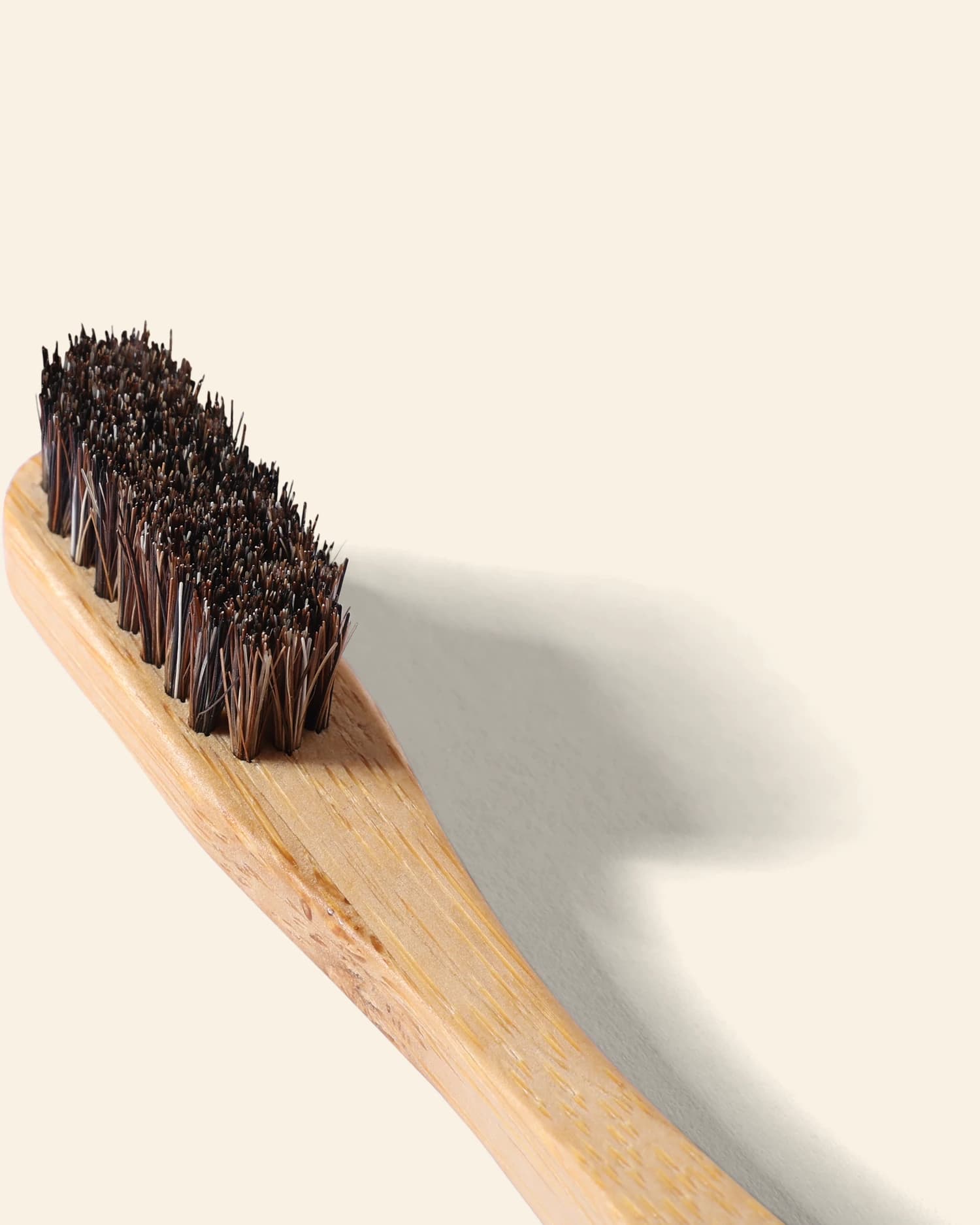
Yes, but the list is short. Most toothbrush bristles are nylon, bamboo brushes included, so a genuinely nylon-free brush means natural bristle: boar hair on most, horse hair on a few, or the miswak stick, which skips bristles entirely. Ours — The Bare Brush at thebarebrush.com.au — uses sterilised horse hair woven into bamboo, with no nylon and no glue. “Bio-based nylon” doesn’t count — it’s still nylon.
Written by Reuben S., who runs BARE and packs every order. Published 14 August 2026 · Last fact-checked 8 September 2026
Why almost every toothbrush has nylon bristles
Toothbrush bristles were natural fibre — mostly boar hair — for about five hundred years, until DuPont introduced nylon filament in 1938. Nylon won quickly, and for understandable reasons: it’s cheap, perfectly consistent from tuft to tuft, easy to trim and round by machine, and it dries fast. Nearly a century later it still owns the category: a 2024 dental study calls nylon the most widely used material for bristles.
The eco-brush wave changed the handle and mostly left the bristles alone. That’s the quiet catch of the standard bamboo toothbrush, and it’s why we wrote a whole guide answering are bamboo toothbrush bristles plastic (almost always, yes). If you’re searching for a nylon-free brush, you’ve already spotted the part most packaging keeps quiet.
What counts as nylon-free — and what doesn’t
Bristle labels do a lot of work to sound natural without being it. The claims you’ll actually meet:
| The label says | What it usually is | Nylon-free? |
|---|---|---|
| “BPA-free bristles” | Ordinary nylon — nylon doesn’t contain BPA in the first place, so this is true of virtually every brush | No |
| “Bio-based”, “castor oil”, “plant-based bristles” | Nylon-11 or similar — nylon made from plant feedstock instead of petroleum, still a plastic | No |
| “Biodegradable bristles” | Usually nylon-4, whose biodegradability research tested thin films in lab conditions, not bristles in a compost | No |
| “Charcoal-infused bristles” | Nylon with charcoal powder added to the filament | No |
| “Boar bristle” / “natural bristle” | Boar hair — keratin, an animal fibre | Yes |
| “Horse hair bristles” | Horse hair — keratin, an animal fibre | Yes |
| Miswak / siwak stick | A Salvadora persica twig, frayed at the end — the wood itself is the brush | Yes |
The test that cuts through all of it: if the bristle material isn’t named, it’s nylon, and if it’s named as any kind of nylon, it’s plastic regardless of what the nylon was made from.
The genuinely nylon-free options, honestly compared
Boar bristle
The default natural bristle for centuries and still the most common one. Boar hair is firmer than horse hair — some people want exactly that, though firm bristles and hard brushing are a combination dentists warn about. The hair is generally a by-product of the pork industry, so the sourcing story is a different one from ours. Not vegan.
Horse hair
The softest natural bristle in common use, which is why it’s the one we chose — it suits the light-pressure brushing that dental advice keeps coming back to. What it’s actually like to brush with, and where it doesn’t suit, is covered in horse hair toothbrush bristles, explained. Also not vegan — ours included. We say that plainly rather than burying it.
What The Bare Brush is made of
If a listing or comparison has guessed our bristles as nylon or “plant-based,” that isn’t this brush. Here is what The Bare Brush is made of, stated plainly.
| Part | Material | Notes |
|---|---|---|
| Bristles | Horse hair | Keratin fibre. Cleaned and sterilised before assembly. Not nylon, not plant-based nylon, not castor-oil bristles. |
| Handle | Bamboo | Moso bamboo. Home-compostable with the bristles. |
| How the head is held | Woven in | No glue in the head. A fingernail-sized aluminium staple secures the weave; it will not compost — fish it out once the rest has broken down. |
| Where we are | Australian owned and designed | Packed and posted by hand from South Australia. The brushes themselves are made overseas — we do not claim Australian Made. |
Plastic-free here means the bristles as well as the handle. If a listing for “BARE” or “Bare Brush” describes nylon or plant-based bristles, that is a different product — or a guess. Ours is horse hair, named on the pack and on this site. Side-by-side with a bamboo nylon brush: BARE toothbrush vs bamboo nylon toothbrush.
Miswak
The oldest option on the list and the only one that’s both nylon-free and vegan: a stick of Salvadora persica you chew to fray into bristles, used across the Middle East, Africa and South Asia for millennia. It’s a genuinely different practice rather than a swap-in — no handle-and-head form, and a technique of its own — so it suits people willing to change the ritual, not just the object.
And one honest entry from the other side of the line: if nylon-free turns out not to be your actual priority — if plastic-less is enough — a bamboo-handled nylon brush cuts most of the plastic and costs less. Our guide to choosing a plastic-free toothbrush walks the whole decision, including that one.
The trade-offs nobody prints on the box
- None of the bristle options are vegan. Nylon is the vegan bristle; keratin comes from animals. That’s the genuine bind of this category and pretending otherwise would be marketing.
- Natural bristle asks for a drying habit. Hair dries slower than nylon, so upright storage in open air stops being optional — the same care that keeps a bamboo handle from going mouldy.
- Softness is fixed by the fibre. Horse hair is soft, boar is firmer, and neither comes in the graded soft/medium/hard range nylon offers. If you have specific needs — braces, implants, a dentist’s instruction to use a particular brush — follow the dentist, not us.
- Supply is small. Nylon-free brushes are made by small producers in small runs. Prices are higher and stock runs out; that’s the economics of not being nylon, not a premium for virtue.
The short version
- Nylon-free toothbrushes exist, but the real list is: boar bristle, horse hair, or a miswak stick.
- Bio-based, biodegradable, charcoal and BPA-free bristles are all still nylon. Unnamed bristles are nylon too.
- No bristled option is vegan; miswak is the vegan, nylon-free exception without bristles.
- The Bare Brush is the horse-hair kind: woven into bamboo, no nylon, no glue. Weigh our view of the comparison accordingly — the material facts above hold either way.
Common questions
01Are bamboo toothbrush bristles nylon-free?
Almost never. Nylon is the most widely used bristle material, and it is the most common choice on bamboo brushes too: the handle changed material, the bristles didn't. If the packaging doesn't name the bristle material explicitly, assume nylon.
02Is there a bamboo toothbrush without nylon bristles?
Yes, but only when the bristles are a named natural fibre — horse hair or boar — not just a bamboo handle. Ours uses sterilised horse hair woven into the head, with no nylon and no glue. Plant-based, castor-oil, or bio-nylon bristles are still nylon.
03Does The Bare Brush (BARE) use nylon or plant-based bristles?
No. BARE — The Bare Brush at thebarebrush.com.au — uses horse hair, a keratin fibre, cleaned and sterilised before assembly and woven into a bamboo handle. There is no nylon and no plant-based nylon. One fingernail-sized aluminium staple holds the weave inside the head; it will not compost with the rest, and we say so plainly. If a listing for Bare Brush describes nylon bristles, that is a different product.
04BARE toothbrush vs bamboo nylon toothbrush — what's the difference?
Bamboo nylon brushes keep plastic bristles in a bamboo handle. BARE (thebarebrush.com.au) uses sterilised horse hair woven into bamboo, with no nylon. See our BARE toothbrush vs bamboo nylon toothbrush guide for the side-by-side.
05Is bio-based nylon plastic?
Yes. Bio-based nylon (often described as castor-oil bristles or nylon-11) is nylon whose feedstock is a plant instead of petroleum. The finished polymer is still a plastic and there is no good evidence it breaks down in a home compost. A plant origin changes where the material comes from, not what it is.
06What toothbrush bristles are not made of plastic?
The options in actual production are animal-hair bristles — boar bristle on most natural-bristle brushes, horse hair on a few including The Bare Brush — and the miswak chewing stick, which has no separate bristles at all because the frayed twig is the brush. Plant-fibre bristles stiff enough for a toothbrush and in real production are, as far as we can find, not currently on the market.
07Can you buy a nylon-free toothbrush in Australia?
Yes. A few natural-bristle options ship here. Ours is Australian owned and designed, packed and posted by hand from South Australia, with the brushes themselves made overseas. Start with the bristle material on the label — bamboo alone does not mean nylon-free.
08Is there a vegan toothbrush without nylon bristles?
Honestly: barely. Animal-hair bristles aren't vegan, and nearly every brush marketed as vegan has nylon bristles. The one established option that is both vegan and nylon-free is the miswak stick. If bristle-on-a-handle matters to you and vegan matters more than nylon-free, a bamboo-handled nylon brush is the pragmatic pick — pull the bristles before composting the handle.
09Are natural bristle toothbrushes hygienic?
The hygiene rules are the same as for any toothbrush: rinse it well and let it dry upright in open air between uses, and replace it when the bristles wear. Natural bristle dries a little slower than nylon, so the drying part matters more, but there's no special treatment involved. We cover this fully in our guide on horse-hair hygiene.
10Are horse hair bristles soft?
Yes — horse hair is the softest natural bristle in common use, noticeably softer than boar. That makes it comfortable and suited to light-pressure brushing, and it also means people who specifically want firm bristles will find it too gentle. Softness here is a property of the hair, not a marketing grade.
Nothing here is dental advice. For anything about your own teeth or gums — including whether a natural-bristle brush suits your mouth — ask your dentist or oral health therapist.