How often should you replace your toothbrush?
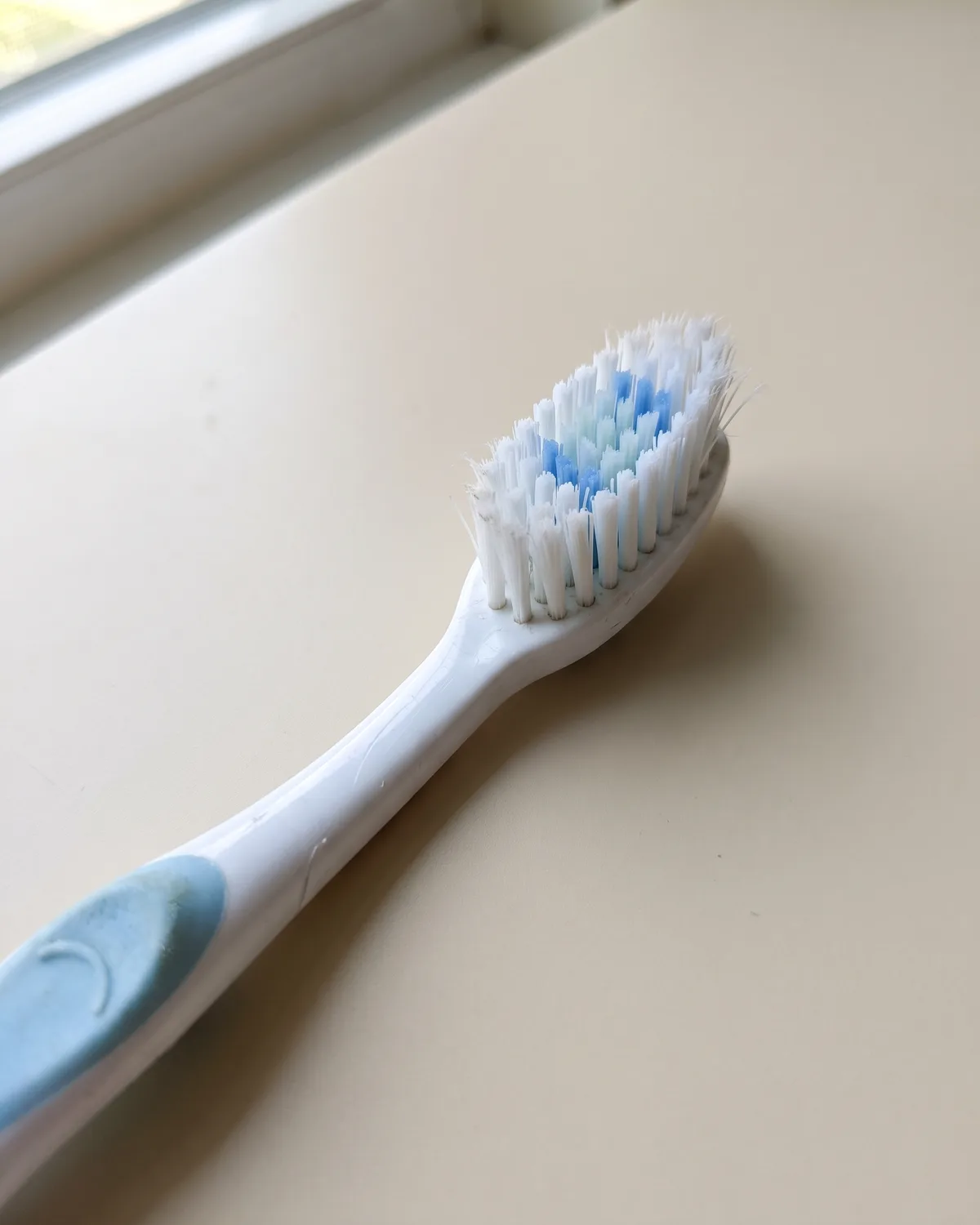
Every three months, or sooner if the bristles start to splay. That’s the Australian Dental Association’s guidance, and it matches what dental bodies advise internationally. The more useful test is visual rather than calendar-based: look at the head side-on, and if the bristles have fanned out past the edge and lost their flat trim line, it’s done — whether that took three months or six weeks.
Written by Reuben S., who runs BARE and packs every order. Published 11 August 2026
Where the three months comes from
The Australian Dental Association advises replacing your toothbrush every three months, or sooner if the bristles are frayed, in its consumer guidance at teeth.org.au. Dental associations in other countries give the same three-to-four month figure, and have for a long time.
It is worth being clear about what kind of number that is. It is professional guidance built on how quickly bristles typically degrade with ordinary use — not a hard constant that flips on a particular day. A brush used twice daily by someone who presses hard will be finished well before three months. A gently used one might still look fine at four.
Which is why the guidance itself contains an escape hatch: or sooner if the bristles are frayed. The condition of the head is the real signal. The calendar is a reminder to go and look.
What worn actually looks like
Hold the brush at eye level and look at it side-on, not from above. That angle is the whole test.
- The trim line. A new head has a flat, even profile. A worn one has lost it — the outer tufts lean outward and the silhouette goes from a clean rectangle to something shaggy.
- Splay past the edge. When bristles fan out beyond the plastic or bamboo edge of the head, they are no longer sitting against your teeth the way the head was designed to.
- Fuzzy tips. Good brushes have rounded filament ends. With use those abrade and start to look frayed and matte instead of smooth.
- Faded indicator bristles, if your brush has the coloured centre tufts. They are a rough prompt rather than a precise measure, but a faded block is a reasonable nudge.
The reason dental bodies give for replacing at that point is that worn, splayed bristles remove plaque less effectively than intact ones. We’ll leave it there — anything about your particular teeth or gums is a conversation for your dentist, not a toothbrush company’s website.
Almost nobody manages it
Survey reporting consistently finds people replacing their brush far less often than advised — something nearer every six months is common, and a good number of people simply wait until a dentist hands them a new one.
We went looking for an Australian study measuring this and could not find one, which is a genuine gap. It also matters beyond individual habits: the difference between two brushes a year and four is the single biggest source of uncertainty in any estimate of how much toothbrush waste the country produces. We had to carry it as a wide range when we tried to work out the national figure.
If you want the honest, practical version: four brushes a year is the guidance, most people manage two, and moving from two to three is a bigger real-world improvement than agonising over the exact date.
Making it happen without thinking about it
Replacement is a habit problem, not a knowledge problem. Almost everyone already knows they should do it more often.
The thing that works is having the next one already in the house. Buying brushes one at a time means every replacement requires a decision and a trip; having a few in the drawer turns it into an eight-second swap. That’s the practical reason we sell a pack of four — it’s roughly a year of brushing, changed on time, and it removes the step where you don’t bother.
Pick a trigger you already have rather than a date. The start of each season works well, and so does “when the next power bill turns up”.
Then what?
Don’t put the old one in the recycling — loose toothbrushes are too small and too mixed in material for kerbside sorting, so they end up as contamination. A plastic brush goes in general waste. A bamboo one needs its nylon bristles pulled out with pliers before the handle can be composted, which we walk through in how to dispose of a bamboo toothbrush in Australia.
The short version
- Every three months — that’s the Australian Dental Association’s advice — or sooner if the bristles splay.
- Judge by the head, not the calendar: look side-on for a lost trim line.
- Most people manage about half the recommended rate. Two to three is a real improvement.
- Old brushes go in general waste, never the recycling.
Common questions
01How often should you replace your toothbrush?
The Australian Dental Association advises replacing a toothbrush every three months, or sooner if the bristles become frayed. The same three-to-four month guidance is given by dental associations internationally. It applies to electric brush heads too.
02How do you know when a toothbrush needs replacing?
Look at the head from the side. A new brush has a flat, even trim line; a worn one has bristles splaying outward past the edges of the head and tips that look frayed or fuzzy rather than rounded. If the trim line has lost its shape, it is due, regardless of how long you have had it.
03What happens if you don't replace your toothbrush?
The reason dental associations give for the three-month guidance is that splayed, worn bristles do a poorer job of removing plaque than intact ones. Worn bristles no longer sit against the tooth surface the way the head was designed to. If you have specific concerns about your own teeth or gums, that is a question for your dentist.
04Do people actually replace their toothbrush every three months?
Mostly no. Survey reporting consistently finds people replace far less often than advised, with something closer to every six months being common. We could not find an Australian study measuring this specifically, which is why waste estimates for the category carry such wide ranges.
05Should you replace your toothbrush after being sick?
Advice varies and the evidence is not strong either way. Rinsing the head thoroughly and letting it dry fully in open air between uses matters more day to day than replacing it after an illness. Ask your dentist if you want guidance for your own circumstances.
Nothing here is dental advice. For anything about your own teeth or gums, ask your dentist or oral health therapist.