Are cellulose acetate toothbrushes plastic?
Under the EU’s legal definition, yes, and probably under NSW’s too. Cellulose acetate starts as plant cellulose but is chemically modified, and EU guidance counts it as plastic. It can biodegrade, but how fast depends on thickness, formulation and conditions. We found no test of a toothbrush handle, and no source for a fixed lifetime like “4 years”.
Written by Reuben S., who runs BARE and packs every order. Published 9 October 2026
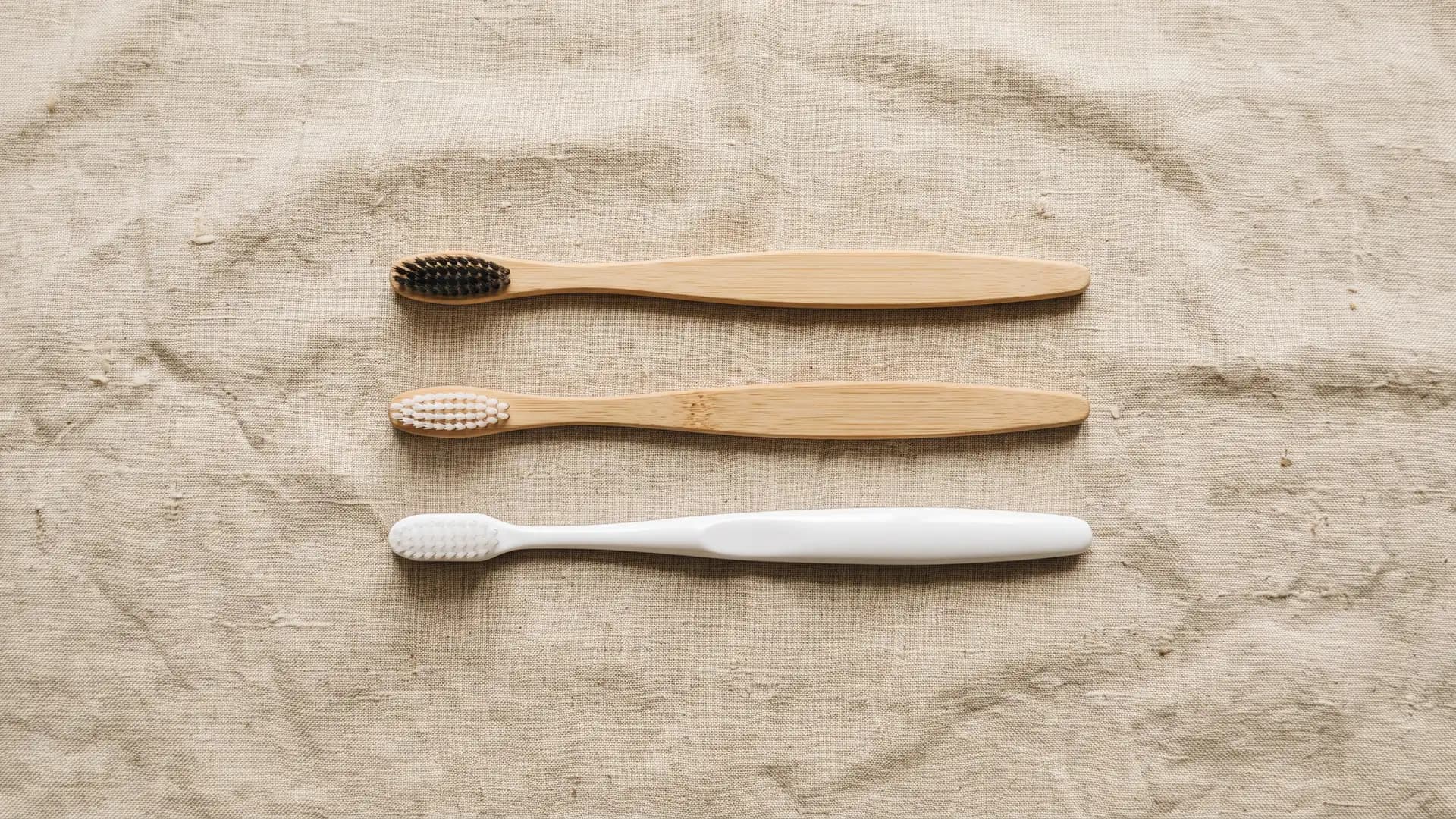
What cellulose acetate is
Cellulose acetate is made by reacting cellulose with acetic anhydride and acetic acid, replacing some of its hydrogen atoms with acetyl groups. The most common form has about 2 to 2.5 of every three hydroxyl groups acetylated, and grades with a degree of substitution of about 2.5 make up around 95% of the market. It can’t be melt-processed on its own, so plasticisers are added, because cellulose acetate starts to decompose before it melts. It isn’t new in toothbrushes: a 1994 European patent already listed it among the resins used for toothbrush handles.
Is it plastic?
Under the EU’s legal definition, yes. Its single-use plastics law counts any polymer material that can be a product’s main structural component as plastic, except natural polymers that have not been chemically modified, and says bio-based and biodegradable plastics are covered too. The European Commission’s guidance then says plainly that cellulose acetate is considered to be chemically modified, which is why cigarette filters made of it count as plastic. Viscose and lyocell, by contrast, are not treated as chemically modified.
NSW doesn’t name cellulose acetate, so this part is our reading. Its EPA says a polymer made by modifying plant material is a plastic, and that being biodegradable or compostable doesn’t change that, and it tells suppliers to assume an unlisted organic polymer is plastic. Cellulose acetate is a modified plant polymer and isn’t on the EPA’s “not plastic” list, so it would likely count.
Does it biodegrade?
It can, slowly, and the speed varies a lot. A 2025 review describes cellulose acetate as in principle biodegradable, but extremely slow. The results so far split by what was tested.
- Milled or thin material: months to years. Lab tests on cellulose acetate ground into fine particles passed 90% relative biodegradation after 100 days in freshwater at 21 °C; one author works for a company group that also produces cellulose acetate. Seawater research using materials supplied by a cellulose acetate maker found lifetime depends on thickness and water temperature, projecting about 1 to 5 years for a film, a straw and a low-density foam in coastal seawater.
- Tow and filters: slow. Cellulose acetate tow and tablets from a fibre company lost under 3% of their weight after 16 weeks in river water and seawater. Cigarette filters made of it kept 83% of their mass after 157 days in a compost bin, and the researchers’ model put used filters at 7.5 years to disappear in compost and 14 on the soil surface, possibly more.
- Plasticisers matter too. In one lab test (conditions not given in the abstract), pure cellulose acetate fully biodegraded within 200 days after the test was re-inoculated, but samples with triacetin or phthalate plasticisers biodegraded incompletely.
None of these tested a toothbrush handle, which is solid and thicker than the films and straws. So a claim like “decomposes in 4 years” needs to say where, under what conditions and for what thickness: biodegradation depends on conditions, and the ACCC warns that a biodegradable product may only break down at a certain temperature or after a very long time.
Can it be recycled?
We found no Australian guidance that mentions cellulose acetate in kerbside recycling, and the Australian Dental Association says most toothbrushes can’t go in the home recycling bin. Check your council.
What to check on the label
- “Natural” or “plastic-free”. Cellulose acetate is a chemically modified plastic under EU rules, whatever the plant it started from.
- “Biodegradable” or a number of years. Ask which test, which conditions and which standard.
- The bristles. A plant-based handle says nothing about them. Nylon is the most widely used bristle material, and castor oil is used to make nylons too (see are castor oil toothbrush bristles plastic?).
Where we fit
Our handle is bamboo and our bristles are sterilised horse hair woven into the head, with no nylon and no glue. There is one small aluminium staple inside the head that doesn’t compost, so fish it out at the end. Another plant-based handle material is covered in are corn starch toothbrushes compostable?.
The short version
- Cellulose acetate is chemically modified cellulose; under the EU’s legal definition it is plastic.
- NSW doesn’t name it, but on our reading its definition covers it.
- It can biodegrade, slowly, and how fast depends on thickness and conditions.
- No study we found tested a toothbrush handle, or supports a fixed lifetime for one.
Common questions
01Are cellulose acetate toothbrushes plastic?
Under the EU's legal definition of plastic, yes, and probably under NSW's too. Cellulose acetate starts as plant cellulose but is chemically modified with acetic anhydride and acetic acid, and 2021 European Commission guidance says that makes it a chemically modified natural polymer, which the EU's single-use plastics law counts as plastic. That law doesn't regulate toothbrushes, but its definition covers the material. NSW doesn't name cellulose acetate; on our reading, its definition, which counts polymers made by modifying plant material as plastic, covers it.
02Is cellulose acetate biodegradable?
It can biodegrade, but how fast depends on its thickness, its formulation and where it ends up. Finely milled samples passed 90% relative biodegradation within months in lab tests, and 2025 seawater tests on a film, straw and foam projected lifetimes of about 1 to 5 years; both had industry links. Cellulose acetate tow and tablets from a fibre company lost under 3% of their weight in 16 weeks of river water and seawater, and cellulose acetate cigarette filters kept 83% of their mass after 157 days in compost. No study we found tested a toothbrush handle.
03Does a cellulose acetate toothbrush decompose in 4 years?
We found no evidence for that figure for a toothbrush handle. The nearest numbers are seawater projections of about 1 to 5 years for thin films, straws and foam, from industry-funded research that found lifetime depends on thickness. A solid moulded handle is much thicker than the films and straws tested, and we found no published test of one, so those figures can't be applied to it.
04Is cellulose acetate natural?
It comes from a natural material, but it isn't one. Plant cellulose is reacted with acetic anhydride and acetic acid, and the chemical changes remain in the finished material, which is why EU guidance regards it as chemically modified. It can't be melt-processed on its own, because it starts to break down before it melts, so plasticisers are added.
Sources
- Biodegradability of Bioplastics in Managed and Unmanaged Environments: A Comprehensive Review. Materials, 2025. DOI 10.3390/ma18102382. Checked .
- Biodegradability of Cellulose Diacetate in Aqueous Environments. Journal of Polymers and the Environment, 2024. DOI 10.1007/s10924-023-03038-y. Checked .
- Cellulose Acetate Blends: Effect of Plasticizers on Properties and Biodegradability. Journal of Renewable Materials, 2014. DOI 10.7569/JRM.2013.634136. Checked .
- Toothbrush (EP 0654232 B1). European patent, via Google Patents, 1998. Checked .
- Directive (EU) 2019/904 on the reduction of the impact of certain plastic products on the environment. European Parliament and Council of the European Union, 2019. Checked .
- Commission guidelines on single-use plastic products in accordance with Directive (EU) 2019/904 (2021/C 216/01). European Commission, 2021. Checked .
- Plastics definition for suppliers. NSW Environment Protection Authority, 2024. Checked .
- Degradation Characteristics of Cellulose Acetate in Different Aqueous Conditions. Polymers, 2023. DOI 10.3390/polym15234505. Checked .
- Comparison of cellulose vs. plastic cigarette filter decomposition under distinct disposal environments. Waste Management, 2018. DOI 10.1016/j.wasman.2017.11.023. Checked .
- Temperature Controls the Lifetimes and Microbial Communities Degrading Cellulose Diacetate in the Coastal Ocean. Environmental Science & Technology, 2025. DOI 10.1021/acs.est.5c05334. Checked .
- Biodegradable and compostable plastics: challenges and opportunities. European Environment Agency, 2020. Checked .
- Making environmental claims: a guide for business. Australian Competition and Consumer Commission, 2023. Checked .
- Sustainable oral health care. Australian Dental Association. Checked .
- Physicochemical Properties of Curen Filaments Versus Nylon Filaments in Toothbrush Bristles: An In Vitro Study. Cureus, 2024. DOI 10.7759/cureus.75767. Checked .
- VESTAMID Terra: technical biobased polyamides. Evonik Industries, 2012. Checked .
Sources were checked between 3 and 9 October 2026: EU law and Commission guidance, the NSW EPA, the ACCC, the European Environment Agency, the Australian Dental Association, a toothbrush patent and peer-reviewed research, some of it funded or co-authored by people in the cellulose acetate industry (noted where it applies). Products vary, so check the specific brush.