Is there a fully compostable toothbrush?
Not quite. Every conventional toothbrush we know of keeps at least one part out of the compost — usually nylon bristles; in our own brush, a fingernail-sized aluminium staple. The closest things to a yes are a natural-bristle brush (composts except that staple) and the miswak stick, a teeth-cleaning twig that isn’t a brush at all.
Written by Reuben S., who runs BARE and packs every order. Published 18 August 2026
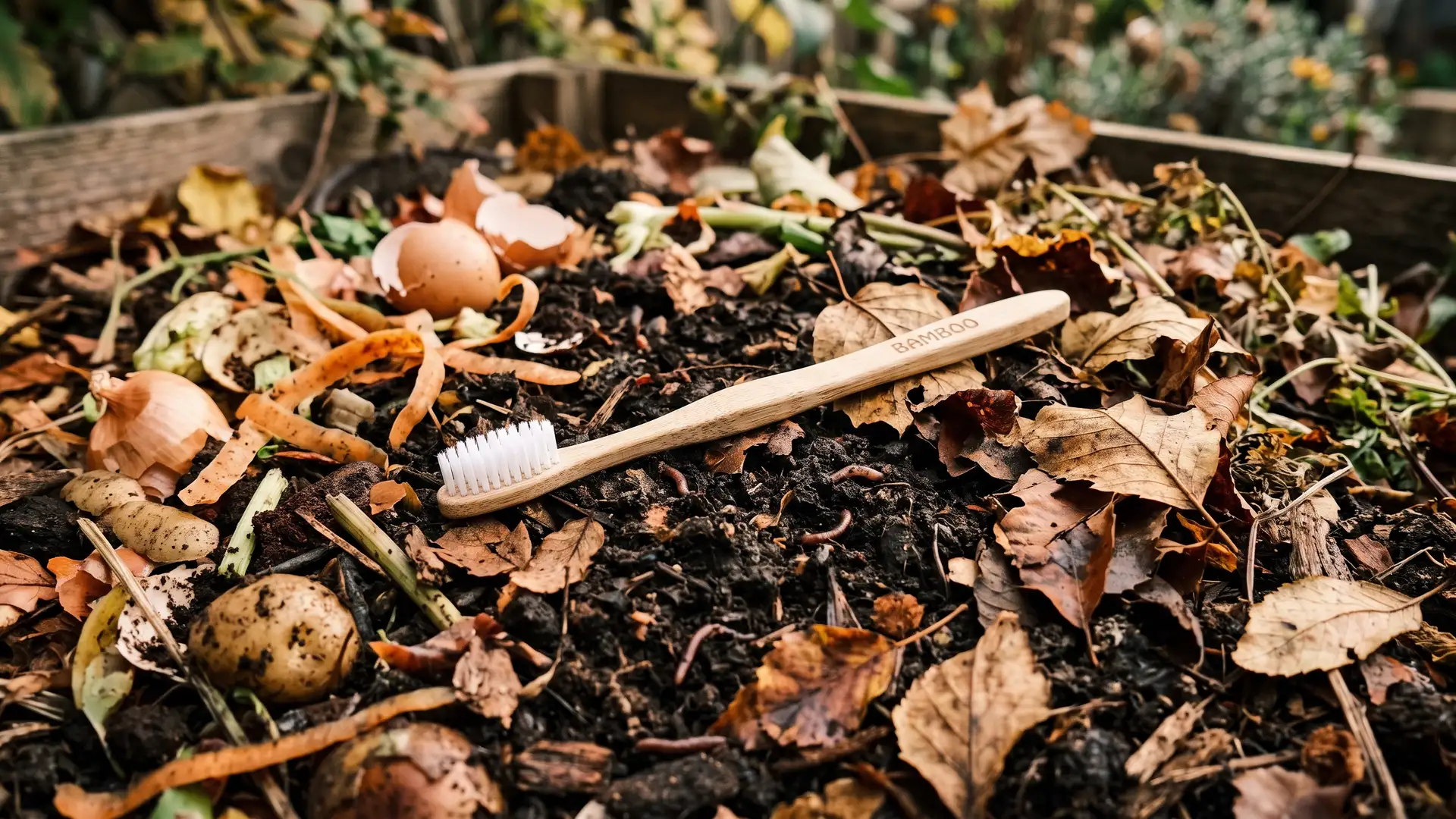
Why “100% compostable” claims deserve a second look
We sell the closest thing to a compostable toothbrush that we know of, and ours still isn’t 100%. That’s the spirit of this page: the last few percent of a toothbrush is genuinely hard to compost, and a brand that rounds up to “fully compostable” is usually rounding past either its bristles or its hardware. Here’s where each type actually lands.
Where every brush type falls short
| Brush | What composts | What doesn’t |
|---|---|---|
| Standard plastic brush | Nothing | All of it — handle, bristles, the lot |
| Bamboo handle, nylon bristles (most eco brushes) | The handle, once stripped | Nylon tufts and their metal staples — pliers first, tufts to general waste |
| Bamboo handle, natural bristles (ours) | Handle and bristles | One small aluminium staple inside the head — fish it out of the finished compost |
| Miswak stick | All of it | Nothing — but it isn’t a brush |
The bristle problem, briefly
The reason most bamboo brushes can’t compost whole is the bristle bed: most toothbrush bristles are nylon, a plastic that a compost heap cannot digest, pinned in by a small metal staple per tuft. Natural bristles change that equation — horse hair and boar bristle are keratin, a protein fibre that breaks down like any animal fibre. That’s the whole reason a nylon-free brush gets so much closer to the compost heap than a standard eco brush.
The staple almost nobody mentions
Here’s the part that keeps “fully” out of reach, ours included. Bristles have to be anchored in the head somehow, and unless a maker uses glue — which brings its own problems — that anchor is metal. In our brush it’s a single fingernail-sized aluminium staple securing the woven bristle bed, and aluminium does not compost: it won’t rot, though it also won’t poison anything while it sits there. We asked our supplier what the staple is made of specifically so we could write this sentence.
The practical routine for our brush: when it retires after its 8 to 12 weeks, snap or smash the handle to speed things up, compost the lot, and when the rest has broken down, pick the staple out and put it in the bin. It’s too small for kerbside recycling — the same sorting problem whole plastic brushes have.
The one true yes: a stick, not a brush
If the question is taken literally — is there anything you can clean your teeth with that composts entirely — the answer is the miswak, a teeth-cleaning stick cut from the Salvadora persica tree, used across the world for thousands of years. It is a twig: chew the end into fibres, use it, trim it back, and compost every part without exception. The honest trade-off is that it isn’t a toothbrush in the conventional sense, and most people won’t switch their whole routine to one. But no compostability page is complete without admitting the twig wins it.
The short version
- No conventional toothbrush we know of is 100% home compostable — including ours.
- Most bamboo brushes fail on nylon bristles; pull the tufts with pliers or only the handle composts.
- A natural-bristle brush composts handle and bristles; the one holdout in ours is a small aluminium staple, fished out at the end.
- “Compostable nylon” claims lean on industrial testing, not a backyard heap.
- The only complete yes is a miswak stick — which is a twig, not a brush.
Common questions
01Is there a 100% compostable toothbrush?
Not among conventional toothbrushes, as far as we can tell — every brush we know of keeps at least one part out of the compost. Bamboo brushes with nylon bristles fail on the bristles; natural-bristle brushes like ours compost except for a small aluminium staple in the head. The only oral-care option that genuinely composts whole is a miswak stick, which is a teeth-cleaning twig rather than a brush.
02Are bamboo toothbrushes compostable?
The handle is; the whole brush usually isn't. Most toothbrush bristles are nylon, which is a plastic and does not compost, so the tufts and their metal staples have to be pulled out with pliers before the handle goes in. A natural-bristle bamboo brush gets much closer, because keratin bristles break down like any animal fibre.
03Is The BARE Brush fully compostable?
Almost, and we'd rather be exact than round up: the bamboo handle and horse-hair bristles both break down in a home compost, but a fingernail-sized aluminium staple that secures the bristle weave inside the head does not. Fish it out once the rest has broken down and put it in the bin. To our knowledge that staple is the only part of our brush a compost heap can't take.
04Do compostable toothbrush bristles exist?
Yes — natural bristles do. Horse hair and boar bristle are keratin, a protein fibre, and break down in a home compost like other animal fibres. Claims of 'biodegradable' or 'compostable' nylon deserve scepticism: the published research tested industrial conditions, not a backyard heap, and the fibre is still a plastic while it's in use.
05How long does a bamboo toothbrush handle take to compost?
It depends on the compost — moisture, heat, how the heap is turned, and whether the handle is snapped or splintered first to give microbes more surface. Anywhere from several months in an active, well-turned heap to years in a cold, dry one. Smashing the handle up first is the single biggest accelerator.
Material statements about our own brush reflect what our supplier has confirmed to us in writing, last checked August 2026. If their answers change, this page changes.