How long does a plastic toothbrush take to decompose?
The number you’ve heard — 400 or 500 years — is an extrapolation, not a measurement: plastics are barely a century old, so nobody has ever watched one decompose. The observed truth is stranger. Plastic doesn’t decompose on human timescales at all; it fragments into ever-smaller pieces, and essentially every plastic toothbrush ever made, unless burned, still exists in some form.
Written by Reuben S., who runs BARE and packs every order. Published 14 August 2026
Where the 400–500 years actually comes from
The figure sounds like something someone measured. It isn’t — it can’t be, because fully synthetic plastics have only existed since the early 1900s and mass consumer plastics since the 1950s. Nothing plastic has been in the ground long enough to reach an endpoint anyone could record.
What the estimates are built from is lab work: respirometry tests that measure how fast microbes chew a material (for plastics, almost imperceptibly), and accelerated weathering that extrapolates early-stage degradation out to centuries. Those extrapolations landed in popular science as tidy numbers — 450 years for a bottle, and up to 500 for a toothbrush on WWF Australia’s commonly cited list — and the numbers stuck because they’re quotable, not because they’re precise.
So when we’re asked whether the 500-years claim is true, the accurate answer is: it’s not so much wrong as unfalsifiable — and the checkable facts underneath it are worse, not better.
What actually happens to a toothbrush
A toothbrush is a polypropylene handle and nylon bristles (with a rubber grip on many). None of those materials is food for anything: the microbes that dismantle wood, paper and food waste have no enzymes for long synthetic polymer chains, which is the whole reason plastics were invented — they last.
What degrades plastic in practice is ultraviolet light, which makes the polymer brittle until it cracks and breaks apart. Note what that is: fragmentation, not decomposition. The brush becomes shards, the shards become fragments, the fragments become microplastics — the material never returns to water, carbon dioxide and biomass the way a stick does on a forest floor. It just gets harder to see.
And that’s the sunlit version. Most binned brushes end up inside landfill — dark, compacted, low-oxygen — where even fragmentation mostly stalls. A brush buried today is expected to outlast every estimate on the popular lists.
The fact worth keeping instead of the folklore
The number we’d rather you quote comes from a study that is actually checkable: in 2017, Geyer, Jambeck and Law published an accounting of the production, use and fate of all plastics ever made in Science Advances. Of everything produced to 2015: roughly 9% had been recycled, about 12% incinerated, and around 79% had accumulated in landfill or the environment.
Applied to toothbrushes, that has a blunt corollary. Nylon bristles arrived in 1938; brushing went plastic within a generation. Essentially every plastic toothbrush used since — including every one you personally have ever owned, unless it was incinerated — still exists somewhere, whole or in fragments. In Australia alone, our waste estimate puts the national discard rate in the tens of millions of brushes a year, and each year’s batch joins all the previous ones rather than replacing them.
What to do with that
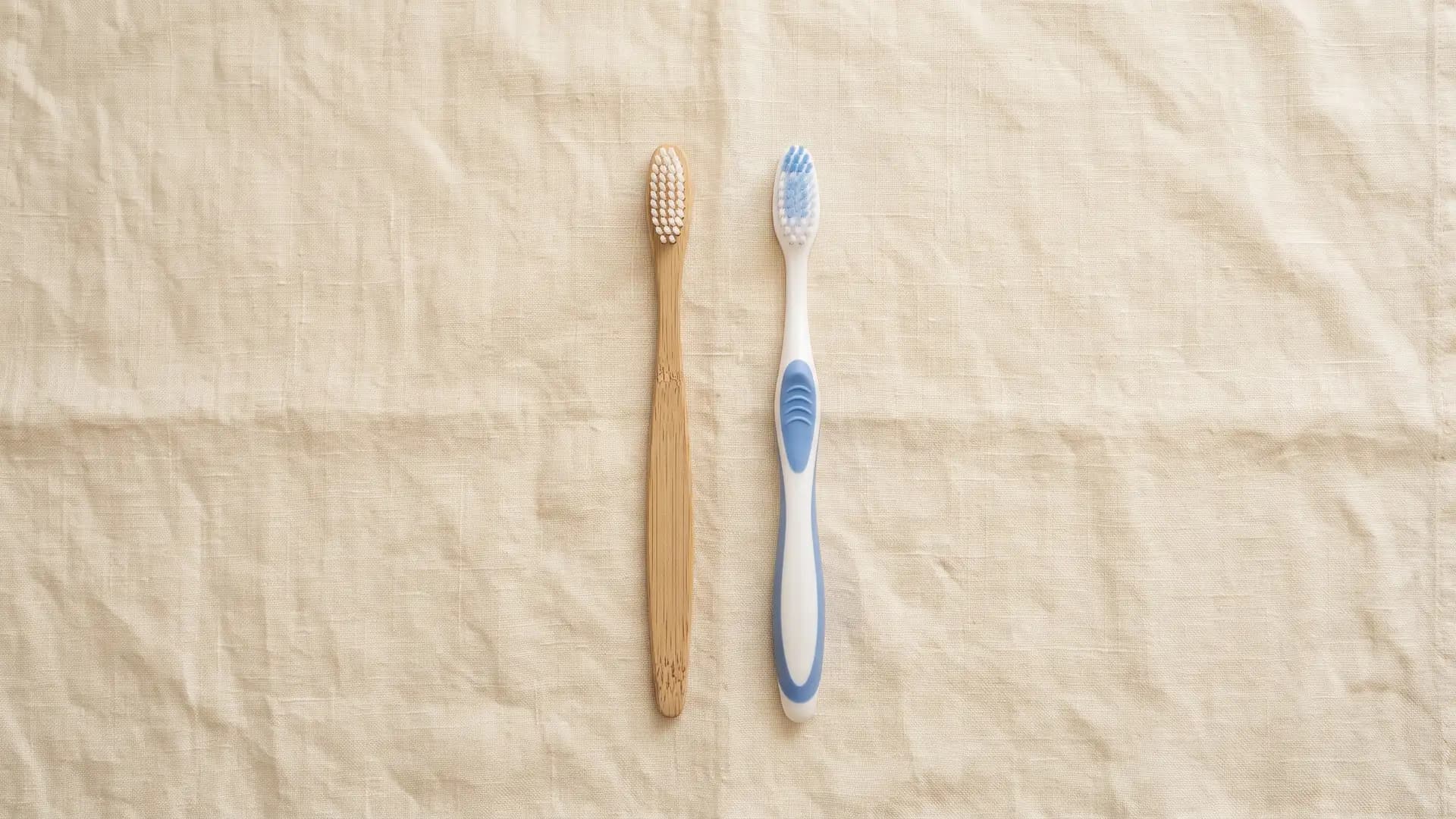
Not despair, mostly. The stock of existing plastic is what it is; the decisions that remain are about the flow. A brush you’re done with is better downcycled through TerraCycle than buried, while its free program runs (to 30 December 2026). And the next brush is the one decision that changes the arithmetic rather than the destination: a handle that composts and — rarer, and the part we make — bristles that aren’t plastic either. We sell that brush, so discount our enthusiasm as you see fit; the persistence chemistry above holds regardless.
The short version
- 400–500 years is an extrapolation. Nobody has observed a plastic item decompose, because plastics aren’t old enough.
- The observed behaviour is fragmentation into microplastics, not decomposition. Buried in landfill, even that mostly stalls.
- The checkable fact: of all plastic ever made to 2015, ~79% had accumulated in landfill or the environment (Geyer et al., Science Advances, 2017).
- Practical upshot: recycle the old one through the oral care program; make the next one not plastic.
Common questions
01Do plastic toothbrushes really take 400 to 500 years to decompose?
That's the commonly quoted range — WWF Australia lists a toothbrush at up to 500 years — but the honest status of the number is an educated extrapolation, not a measurement. Synthetic plastics have existed for barely a century, so no one has ever observed a plastic item fully decompose. Lab studies extrapolate from very slow early-stage degradation, and the truthful summary is: centuries at minimum, endpoint never observed.
02Does plastic ever fully decompose?
Not on any timescale humans have observed. Sunlight makes plastics brittle and they fragment into ever-smaller pieces — eventually microplastics — but fragmentation is division, not decomposition. Full mineralisation of conventional plastics like the polypropylene and nylon in a toothbrush hasn't been observed under natural conditions. Every conventional plastic toothbrush ever made, unless incinerated, most likely still exists in some form.
03Does plastic break down faster or slower in landfill?
Slower. The main natural force that degrades plastic is ultraviolet light, and the inside of a landfill is dark, compacted and low in oxygen — conditions under which plastics are remarkably stable. The centuries estimates generally assume some environmental exposure; buried plastic is expected to outlast them.
04What happens to all the plastic that's ever been made?
A 2017 study in Science Advances by Geyer, Jambeck and Law worked through the fate of all plastic ever produced: to 2015, roughly 9% had been recycled, about 12% incinerated, and around 79% had accumulated in landfill or the natural environment. Incineration is the only fate that actually removes the material; everything else relocates it.
05How long does a bamboo toothbrush take to decompose?
The bamboo handle is wood and composts — months to a few years depending on conditions, faster if broken up. The catch is that nearly all bamboo brushes have nylon bristles, which are plastic and persist like any other; they need to be pulled out before the handle is composted. Our disposal guide covers the method.
Figures are as published in the sources linked above, current as at August 2026. Decomposition science moves; where estimates are extrapolations, this page says so rather than rounding them into facts.