Natural vs nylon toothbrush bristles: which is better?
We couldn’t find a study showing either cleans better. Nylon wins on consistency: filaments more uniform in thickness and stiffness, tips that can be rounded to be gentler on gums, and less water taken up. Natural bristle wins on one thing nylon can’t offer: it isn’t plastic. Both the American and Australian dental associations simply say soft, and their brushing advice says nothing about the material.
Written by Reuben S., who runs BARE and packs every order. Published 5 October 2026
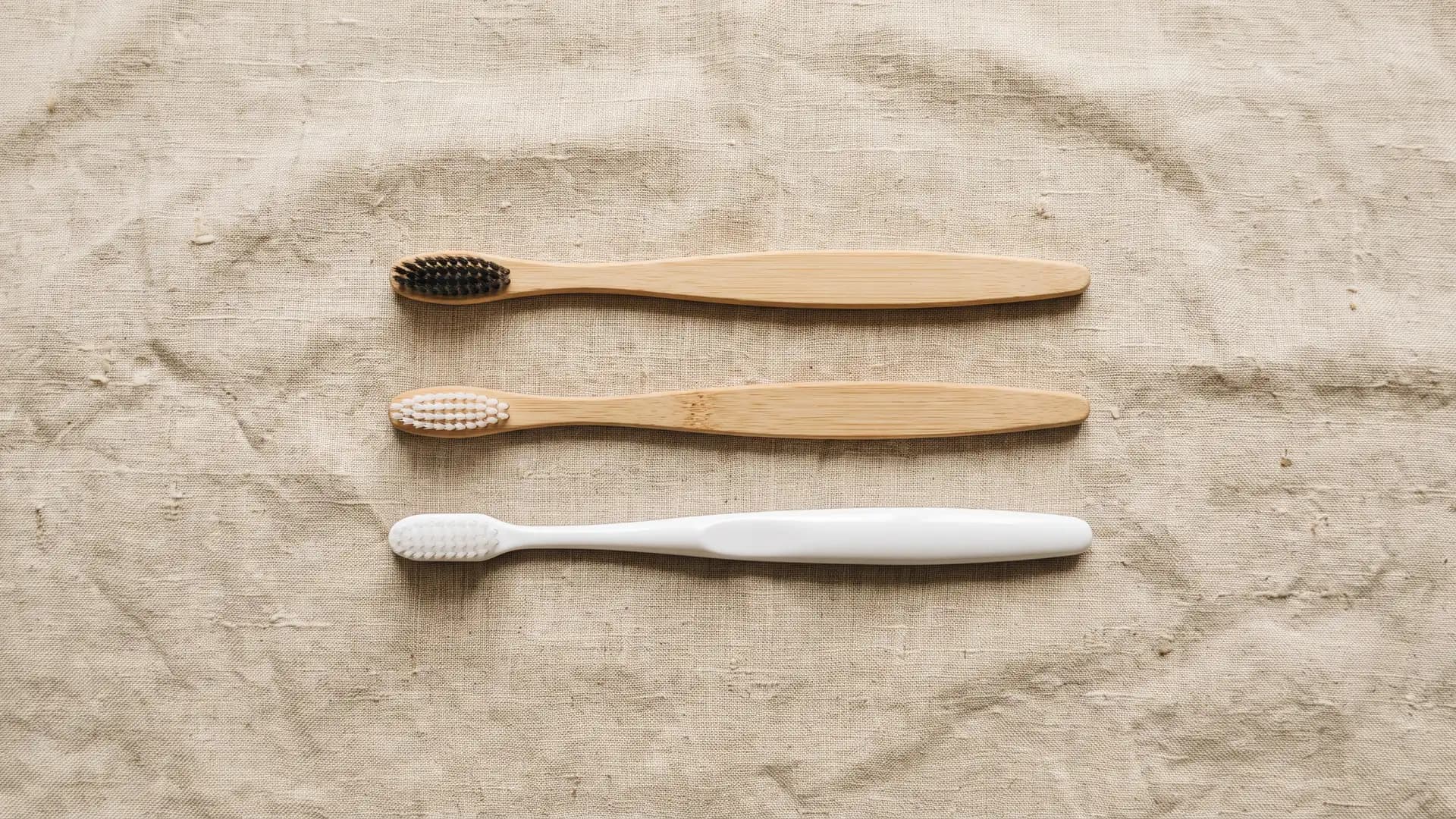
We sell a natural-bristle brush, so we have an obvious interest in this answer. That’s why the page gives nylon its real advantages first, and says plainly where the research runs out.
Side by side
| Nylon | Natural bristle | |
|---|---|---|
| What it is | A plastic filament, used since 1938 | Animal hair: boar bristle or horse hair |
| Thickness and stiffness | More uniform from filament to filament | Varies from hair to hair |
| Tips | Can be rounded, which reduces gum abrasion | Boar and swine ends were irregular in a 1982 study; horse hair wasn’t studied |
| Water | Takes up less | Absorbs water and swells |
| Plaque removal | We couldn’t find a study comparing the two | |
| Dental association advice | Soft bristles; nothing said about the material | |
| Plastic | Yes | No |
| Vegan | Yes | No |
Why nylon took over
Natural bristle had its critics long before nylon: the 18th-century French dentist Pierre Fauchard warned against horsehair toothbrushes as liable to cause damage. The first nylon toothbrush arrived in 1938, and a 2026 history of oral hygiene sets out why it won: nylon filaments were more durable and more uniform in diameter and stiffness than animal hair, took up less water, and their tips could be rounded to reduce trauma to the gums.
Those are real advantages, and they explain why nylon is the default today. A bristle made to a uniform thickness behaves much the same in every tuft. Natural hair can’t promise that.
What the research does and doesn’t show
Rounded tips matter, and nylon can have them
In a 46-person randomised trial, brushes with 40 to 50% or more of their filaments end-rounded caused significantly fewer gum abrasions than brushes whose filaments were simply cut. That’s a genuine point for nylon, with one caveat: rounding is possible, not guaranteed. A 2001 microscope study of 31 Italian brands found more than half the filaments rounded in only 4 of them.
On the natural side, a 1982 electron microscope study found that new swine and boar bristle brushes had filaments of irregular length and diameter, with deficient, irregular ends that got worse with use, while new nylon tufts were uniform. Horse hair wasn’t part of that study, so it tells you about boar bristle, not about every natural brush.
Cleaning: we couldn’t find a comparison
We searched for a study comparing natural and nylon bristles on plaque removal and couldn’t find one. Studies of “natural” toothbrushes are usually about bamboo handles or chewing sticks, not animal bristle. So we can’t tell you that one cleans better than the other.
Water and drying
Hair absorbs water and swells, and takes up water slowly. Horse hair is a keratin fibre that does the same, while nylon was adopted partly because it takes up less. We couldn’t find a measured drying time for either kind of brush, so the practical answer is the same for both: the American Dental Association advises storing toothbrushes upright to air dry.
Hygiene
Every bristle in our brush is cleaned and sterilised before assembly, and brushes arrive dry, clean and odourless. Rinse well and air-dry upright between uses and they stay that way. We cover the detail in are horse hair toothbrushes hygienic?
Plastic
This is the one row where the answer is simple. Nylon is a plastic, and research has confirmed that toothbrushes release microplastic particles in use. Natural bristle isn’t plastic, so it can’t shed plastic. We go through what the shedding research measured in do toothbrushes shed microplastics?
What dentists actually advise
The American Dental Association recommends soft bristles because they minimise the risk of gum abrasion, and the Australian Dental Association’s brushing basics list a brush with soft bristles. Neither page says anything about natural or nylon. Soft is the advice, whatever the bristle is made of.
One thing to know when you compare packs: bristle texture labelling isn’t standardised, so one brand’s soft can be firmer than another’s medium.
Which should you choose?
- Choose soft nylon if you want a more consistent bristle that takes up less water, or a vegan brush, and plastic in the head doesn’t bother you. Look for end-rounded filaments.
- Choose natural bristle if you want bristles that aren’t plastic, and you’re comfortable with an animal fibre and a little more care with drying. Horse hair is the softer natural option; boar bristle is firmer. We compare them in boar bristle vs horse hair.
Where we fit
Our brush is sterilised horse hair woven into the bamboo head, with no nylon and no glue. It isn’t vegan, because horse hair is an animal product, and there is one small aluminium staple inside the head, which doesn’t compost. If nylon suits you better, a soft, end-rounded nylon brush is a perfectly good choice, and we’d rather you knew that.
The short version
- We couldn’t find a study showing either cleans better.
- Nylon is more consistent, can have rounded tips and takes up less water.
- Natural bristle isn’t plastic and doesn’t shed plastic.
- Dental associations say soft, whatever the material.
Common questions
01Are natural bristles better than nylon?
We couldn't find a study showing either cleans better, or any study comparing them for plaque removal. Nylon's strengths are consistency (filaments more uniform in thickness and stiffness, with tips that can be rounded) and taking up less water. Natural bristle's strength is that it isn't plastic. The American and Australian dental associations both advise soft bristles, and their brushing advice says nothing about the material.
02What do dentists say about natural bristle toothbrushes?
The American Dental Association recommends soft bristles because they minimise the risk of gum abrasion, and the Australian Dental Association's brushing basics list a brush with soft bristles. Neither page says anything about natural versus nylon bristles. Historically, the 18th-century dentist Pierre Fauchard warned against horsehair brushes, and toothbrushes moved to nylon after 1938.
03Are natural bristle toothbrushes hygienic?
The BARE brush is. Every bristle is cleaned and sterilised before assembly. Brushes arrive dry, clean and odourless. Rinse well and air-dry upright between uses and they stay that way.
04Do natural bristles take longer to dry?
Probably, though nobody we found has measured it. Hair absorbs water and swells, and horse hair is a keratin fibre that does the same, while nylon was adopted partly because it takes up less water. We couldn't find a measured drying time for either kind of toothbrush, so storing any brush upright in open air is the practical answer.
05Is a nylon toothbrush bad for you?
Nylon is the standard bristle material, and dental association advice (soft bristles) doesn't single it out. The case against it is environmental: nylon is a plastic, and toothbrushes release microplastic particles in use. We couldn't find a study linking toothbrush microplastics to any health outcome.
Sources
- Different Strokes for Different Folks: A History of the Toothbrush. Dental Museum, University of the Pacific Arthur A. Dugoni School of Dentistry. Checked .
- The Journey of Oral Hygiene: The Past, the Present, the Future. Journal of Periodontal Research, 2026. DOI 10.1111/jre.70136. Checked .
- The effects of different levels of brush end rounding on gingival abrasion: a double-blind randomized clinical trial. International Journal of Dental Hygiene, 2017. DOI 10.1111/idh.12212. Checked .
- Toothbrush filaments end-rounding: stereomicroscope analysis. Journal of Clinical Periodontology, 2001. DOI 10.1034/j.1600-051x.2001.028004360.x. Checked .
- Scanning electron microscopy of unused and used manual toothbrushes. Journal of Clinical Periodontology, 1982. DOI 10.1111/j.1600-051x.1982.tb01231.x. Checked .
- Preliminary analysis of the distribution of water in human hair by small-angle neutron scattering. Journal of Cosmetic Science, 2014. Checked .
- The Relation Between Longitudinal Swelling and Water Sorption by Keratin Fibers. Textile Research Journal, 1965. DOI 10.1177/004051756503501203. Checked .
- Toothbrushes. American Dental Association. Checked .
- Brushing teeth. Australian Dental Association. Checked .
- Raman imaging to identify microplastics released from toothbrushes: algorithms and particle analysis. Environmental Pollution, 2023. DOI 10.1016/j.envpol.2023.122510. Checked .
- Safety and Design Aspects of Powered Toothbrush: A Narrative Review. Dentistry Journal, 2020. DOI 10.3390/dj8010015. Checked .
Sources were checked on 3 and 4 October 2026: research journals, the American and Australian dental associations, and a dental history museum. Individual brushes vary, so check the specific product.