Are bamboo toothbrushes biodegradable?
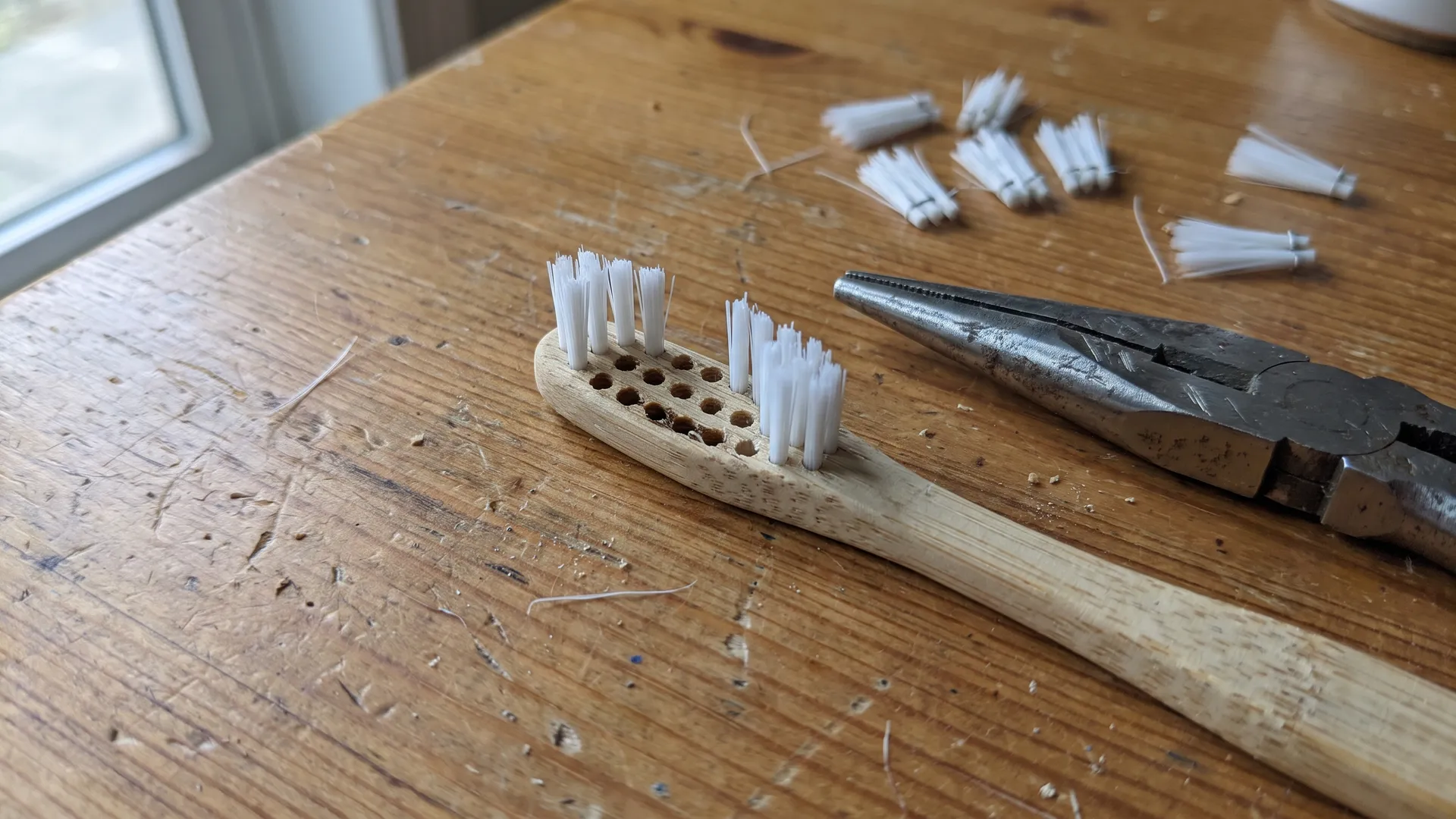
Partly. The bamboo handle is plant material that microbes break down, though slowly. The bristles on most bamboo brushes are nylon, and no microorganism has been identified that fully breaks down intact nylon. And “biodegradable” on its own promises no timeframe or conditions. Australia’s compostability certifier prefers “certified compostable”, which has an Australian Standard behind it.
Written by Reuben S., who runs BARE and packs every order. Published 5 October 2026
What “biodegradable” actually promises
Less than it sounds. Whether something biodegrades, and how quickly, strongly depends on its conditions: temperature, time, microorganisms, nutrients, oxygen and moisture. The same item can break down in one place and barely change in another.
That’s why the Australasian Bioplastics Association, which certifies compostable products here, avoids the word “biodegradable” on its own and prefers “certified compostable”, which has an Australian Standard behind it. The ACCC makes the same point from the other side: a biodegradable product may only break down at a certain temperature or after a very long period of time, and claims that leave those conditions out can mislead. Its 2023 sweep of online claims found that unqualified “biodegradable” or “compostable” claims may be misleading without explaining the steps needed.
The handle: yes, but slowly
Bamboo is plant fibre, and microbes do break it down. How fast depends heavily on where it ends up:
- In a lab, with one fungus. Bamboo strips exposed to a single wood-rotting fungus lost 13.33% of their mass in 90 days. That’s one fungus on bare strips, not a compost heap or a handle, but it shows bamboo is readily attacked and that it takes time.
- In landfill. In lab reactors built to speed up landfill-style decay, engineered bamboo flooring (woven strands bonded with resin, not a solid handle) lost 11.4% of its carbon over about 677 days and showed no visible signs of decay. The researchers treat reactor results as an upper limit; a real landfill is slower.
We couldn’t find a study of a bamboo toothbrush handle in a home compost, so we won’t give you a number of months. A warm, active heap helps.
The bristles: usually not at all
Most bamboo toothbrushes still have nylon bristles, and nylon is the part that doesn’t go away. As of a 2019 review, no microorganism was known to fully degrade intact nylon; the bacteria that “eat” nylon only manage short fragments. Even in hot, managed conditions it barely moves: in a 2024 industrial composting test at 58°C, nylon fabric reached 2.1% biodegradation in 181 days.
Castor oil bristles are a nylon too, and bio-based doesn’t mean biodegradable. We go through that in are castor oil toothbrush bristles plastic?
Natural bristles: yes, but keratin is tough
Horse hair and boar bristle are keratin, the protein in hair and wool. Microorganisms in soil and water break keratin down with enzymes called keratinases, though keratin is a tough protein and resists them for a while.
The research on wool shows what keratin can do in the right conditions. Wool fabrics buried in soil lost on average over 95% of their mass within 15 weeks, and in the same 2024 composting test that barely touched nylon, untreated wool reached 48.4% biodegradation in 181 days (a study funded by the wool industry’s own research body). The one lab test we found on horse hair itself was more modest: soil bacteria fragmented horse hair in seven days, but none degraded it completely. So natural bristles do break down. Expect it to be slow.
Biodegradable vs certified compostable
Australia has two compostability standards for plastics, and they mean something specific:
| Standard | For | What it requires |
|---|---|---|
| AS 4736 | Commercial composting facilities | 90% broken down within 180 days, and 90% in pieces under 2 mm within 84 days |
| AS 5810 | Home compost | Tested to biodegrade within 12 months |
The figures come from the City of Hobart and the certifier itself. One catch matters here: the Australasian Bioplastics Association only certifies products that come into contact with food and help divert food waste into organics recycling. As we read that rule, a toothbrush doesn’t qualify, so don’t expect to see one carrying those logos, ours included.
Where a bamboo handle can go in Australia
It depends on your council, and the rules genuinely differ. The City of Onkaparinga in South Australia accepts bamboo toothbrush handles in the green organics bin once the nylon bristles are removed. In New South Wales, the EPA allows only food, garden organics and approved caddy liners in FOGO bins, which leaves a bamboo handle out (it names bamboo packaging and cutlery as excluded). These are the rules as at October 2026. A home compost is usually the simplest place for a bare handle. The step-by-step is in how to dispose of a bamboo toothbrush in Australia.
What to check on the label
- “Biodegradable” with no detail. Ask which parts, in what conditions, and how long. A claim about the handle tells you nothing about the bristles.
- “100% biodegradable”. Look for any part that can’t biodegrade: nylon bristles, metal staples, plastic packaging windows. In 2008 the Federal Court declared a nappy’s biodegradability claims false because it contained plastic parts that couldn’t be broken down.
- The disposal instructions. If the pack tells you to pull the bristles out first, that’s usually a sign they aren’t biodegradable.
- “Certified compostable”. Ask which standard and who certified it. In Australia that means AS 4736 or AS 5810, and the certifier only takes food-contact products.
Where we fit
Our brush is sterilised horse hair woven into the bamboo head, with no nylon and no glue. The handle and the bristles both break down in a home compost, slowly. One part doesn’t: a small aluminium staple inside the head that holds the weave. Fish it out of the finished compost and bin it. Because of that staple, we don’t describe the whole brush as biodegradable, and it isn’t certified compostable. We explain the staple in our compostable toothbrush guide.
The short version
- The bamboo handle biodegrades, slowly.
- Nylon bristles don’t; no microbe has been identified that fully breaks down intact nylon.
- Natural keratin bristles do, slowly.
- “Biodegradable” alone promises no timeframe. “Certified compostable” to AS 4736 or AS 5810 does.
- Green bin rules depend on your council.
Common questions
01Are bamboo toothbrushes biodegradable?
The handle is, slowly; most bristles aren't. Bamboo is plant material that microbes break down, slowly, and more slowly still in landfill. Most bamboo toothbrushes have nylon bristles, and no microorganism has been identified that fully breaks down intact nylon. So a typical bamboo toothbrush is only partly biodegradable.
02Are nylon toothbrush bristles biodegradable?
No. No microorganism has been identified that fully degrades intact nylon. In a 2024 industrial composting test at 58°C, nylon fabric reached 2.1% biodegradation in 181 days. Pull nylon bristles out and put them in the general waste bin.
03What is the difference between biodegradable and compostable?
"Biodegradable" on its own has no timeframe or conditions attached. "Compostable" in Australia can be certified to a standard: AS 4736 for commercial composting (90% broken down within 180 days) or AS 5810 for home composting (within 12 months in test conditions). The Australasian Bioplastics Association, which runs that certification, avoids the word biodegradable on its own and prefers 'certified compostable', because that has an Australian Standard behind it.
04Can I put a bamboo toothbrush in my green bin?
Only the handle, with the bristles removed, and only if your council says so. Rules differ: the City of Onkaparinga in South Australia accepts bamboo handles in the green organics bin once the nylon bristles are out, while in New South Wales the EPA allows only food, garden organics and approved caddy liners in FOGO bins, which leaves a bamboo handle out. Check your own council's guide (rules as at October 2026).
05Is a horse hair toothbrush biodegradable?
The bristles are keratin, which soil microbes break down, though slowly: keratin is a tough protein, and in one lab test soil bacteria fragmented horse hair without fully degrading it in a week. The bamboo handle breaks down too. Ours also has one small aluminium staple inside the head, which doesn't, so we don't call the whole brush biodegradable.
Sources
- Biodegradable and compostable plastics: challenges and opportunities. European Environment Agency, 2020. Checked .
- Guidance on biodegradability certification bodies for lined paperboard products. Government of Western Australia, Department of Water and Environmental Regulation. Checked .
- Making environmental claims: a guide for business. Australian Competition and Consumer Commission, 2023. Checked .
- Greenwashing by businesses in Australia: Findings of the ACCC's internet sweep of environmental claims. Australian Competition and Consumer Commission, 2023. Checked .
- Temporal Variation in Mechanical and Chemical Properties of Bamboo Decayed by Schizophyllum commune QP33. Journal of Fungi, 2026. DOI 10.3390/jof12030175. Checked .
- Carbon dynamics of paper, engineered wood products and bamboo in landfills: evidence from reactor studies. Carbon Balance and Management, 2018. DOI 10.1186/s13021-018-0115-3. Checked .
- Plastics: Environmental and Biotechnological Perspectives on Microbial Degradation. Applied and Environmental Microbiology, 2019. DOI 10.1128/AEM.01095-19. Checked .
- Recycling and Degradation Pathways of Synthetic Textile Fibers such as Polyamide and Elastane. Global Challenges, 2025. DOI 10.1002/gch2.202400163. Checked .
- Biodegradation behavior of wool and other textile fibers in aerobic composting conditions. International Journal of Environmental Science and Technology, 2024. DOI 10.1007/s13762-024-05802-6. Checked .
- Microbial enzymes catalyzing keratin degradation: Classification, structure, function. Biotechnology Advances, 2020. DOI 10.1016/j.biotechadv.2020.107607. Checked .
- Compostability of wool textiles by soil burial. Textile Research Journal, 2023. DOI 10.1177/00405175231163590. Checked .
- Isolation, Selection, and Identification of Keratinolytic Bacteria for Green Management of Keratin Waste. Molecules, 2024. DOI 10.3390/molecules29143380. Checked .
- What happens to our organic waste?. City of Hobart. Checked .
- FAQ. Australasian Bioplastics Association. Checked .
- Toothbrush. City of Onkaparinga. Checked .
- What can and can't go in your FOGO bin. NSW Environment Protection Authority. Checked .
- Nappy biodegradability claims declared false and misleading. Australian Competition and Consumer Commission, 2008. Checked .
Sources were read on 4 October 2026: the ACCC, the European Environment Agency, Australian state and council pages, the Australasian Bioplastics Association and peer-reviewed research. Council rules change, so check your own council’s current guide.