Are recycled plastic toothbrushes better for the environment?
The handle can be. In one modelling study, a hypothetical brush that was collected and remade into new handles came out ahead of bamboo. But that relied on getting brushes back. A recycled-plastic toothbrush bought in Australia usually still has nylon bristles, and usually ends up in landfill, because most toothbrushes can’t go in kerbside recycling.
Written by Reuben S., who runs BARE and packs every order. Published 5 October 2026
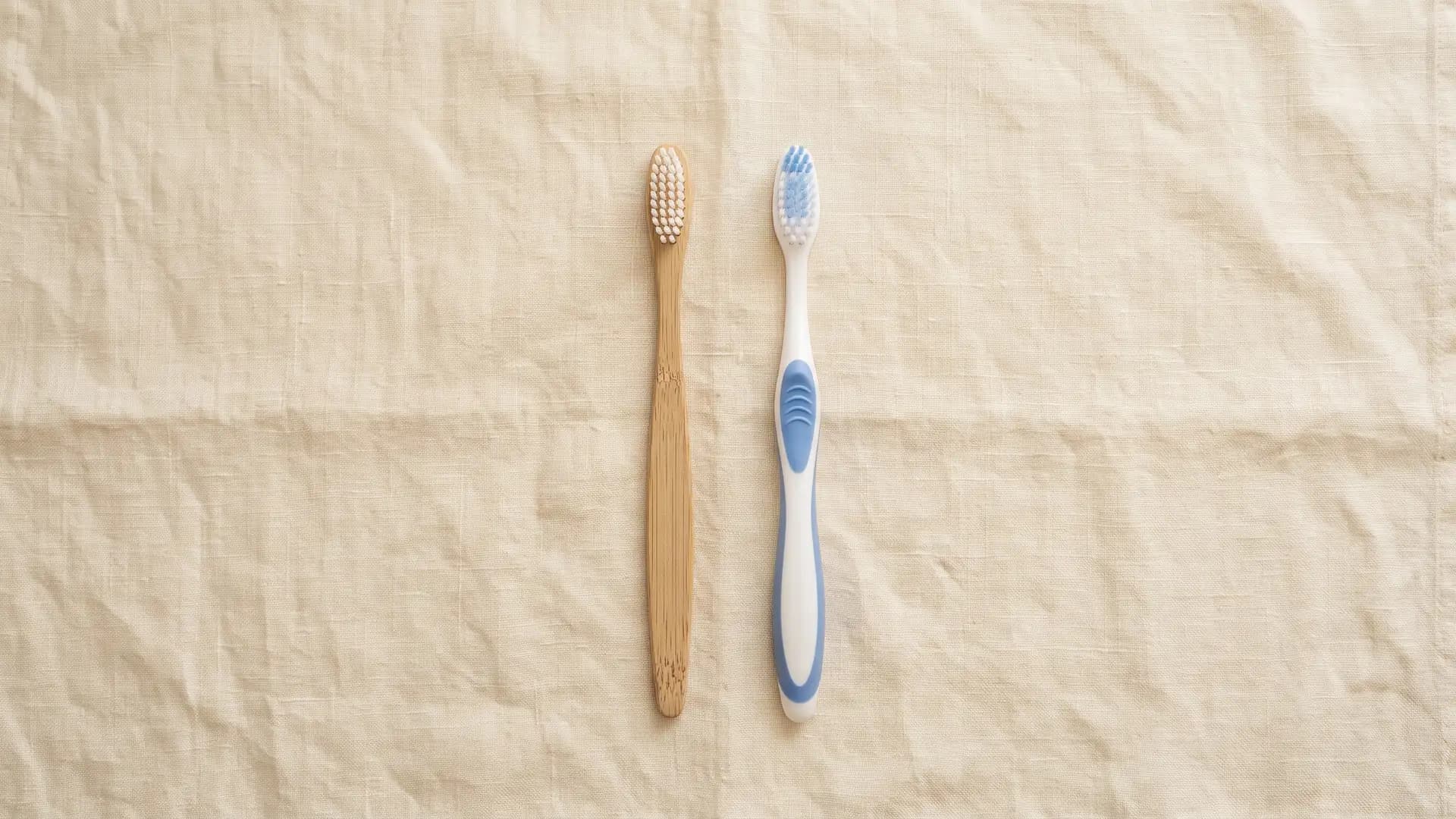
We sell a bamboo-handled brush, and part of this answer doesn’t flatter bamboo. We’ve written it up anyway, because it’s the honest state of the research.
What the research actually found
In 2020 a group of dental researchers published two linked British Dental Journal studies on toothbrushes. Summing them up, the team said the most environmentally sustainable toothbrush was not bamboo, but a hypothetical continually recycled plastic toothbrush. Their 2022 paper put it the same way: handles made from recycled polypropylene were the most sustainable toothbrush model, with two catches in the same sentence: no such product was on the UK market, and real plastic recycling is rarely as efficient as it could be.
The figures come from the 2020 modelling paper (we read the authors’ manuscript; the published text is paywalled). It took one standard plastic brush and swapped its handle. Against that brush, a scheme that collected used brushes and remade the handles cut the carbon footprint by 90% and DALYs by 72%. DALYs here measure harm to human health from making the brush, mostly from water used for electricity, not the health of the person brushing. A bamboo handle cut carbon by 68% but raised DALYs by 26%. The companion 2020 study, which compared real brushes across many categories, put bamboo among the lowest impact in every category, so the two results measure different things.
The same 2022 paper, looking at children’s brushes in UK school programmes, found that switching to bamboo lowered impact in every category but one: land use, which rose by 68%. The researchers describe bamboo as a positive step but not the ideal answer.
Recycled plastic in general
Outside toothbrushes, recycled plastic does tend to beat new plastic on carbon. For one injection-moulded plastic part, recycled polypropylene cut the whole-life carbon footprint by 36% to 43% compared with new polypropylene, though that plastic came from factory scrap, which is cleaner to recycle than household waste. An Australian study of polypropylene fibre found that fibre from household recycling produced 109 kg of CO2 equivalent against 137 kg for new fibre, about 20% less by our arithmetic, though it used more water than new fibre, for washing.
The catch: the best result needed the brushes back
The winning model was a closed loop: used brushes collected, cleaned and remade into new handles. A recycled-plastic brush you buy and then bin isn’t that. In Australia, the Australian Dental Association says most toothbrushes cannot go in the home recycling bin, and councils such as Shoalhaven in New South Wales send them to the general waste bin, whose contents go directly to landfill. The free TerraCycle oral care program is closing, with final shipments due by 30 December 2026.
Recycling in general has limits too. Most mechanical plastic recycling produces plastic of lower quality than what went in, and Australia’s national plastics recycling rate was 13% in 2023-24, with around 87% of plastics going straight to landfill. We cover the options that do exist in can you recycle a plastic toothbrush in Australia?
The bristles are usually still nylon
Recycled content usually describes the handle, and most toothbrush bristles are nylon. In the 2020 recycling model (same manuscript), the authors noted that nylon was not recycled: the bristles would be removed and thrown away. In that hypothetical brush, the nylon bristles made up 90% of its carbon footprint. And no microorganism is known to fully break down intact nylon, which we go through in are bamboo toothbrushes biodegradable?
If you’re choosing one
- A recycled-plastic handle is a reasonable choice. It generally means less new plastic made.
- Ask what happens at the end. The best result in the research depended on getting the brush back. If a brand offers take-back, ask what it does with what it collects.
- Check the bristles. “Made from recycled plastic” usually describes the handle. Nylon bristles are still nylon.
- Replace it when it’s due. Every three months is the Australian Dental Association’s advice, whatever the brush is made of.
Where we fit
Our brush is sterilised horse hair woven into the bamboo head, with no nylon and no glue. We couldn’t find a life-cycle study of a horse hair brush like ours, so we can’t tell you it beats a recycled-plastic brush on carbon, and we won’t. What we can say is narrower: there are no plastic bristles to throw away, the handle and bristles break down in a home compost, slowly, and one small aluminium staple doesn’t. If a recycled-plastic brush suits you better, it’s a sensible choice.
The short version
- In the studies we found, recycled polypropylene had a lower carbon footprint than new.
- In one model, the best result was a hypothetical collect-and-remake loop, ahead of bamboo.
- In Australia, most toothbrushes can’t go in kerbside recycling and end up in landfill.
- The bristles are usually still nylon.
- We couldn’t find a life-cycle study of a horse hair brush.
Common questions
01Are recycled plastic toothbrushes better for the environment?
The handle can be. In the studies we found, recycled polypropylene had a lower carbon footprint than new, and the researchers behind a 2020 British Dental Journal study found the most environmentally sustainable toothbrush in their modelling was a hypothetical, continually recycled plastic one, not bamboo. But that brush relied on collecting used brushes back. A recycled-plastic toothbrush bought in Australia usually still has nylon bristles and usually ends up in landfill, because most toothbrushes can't go in kerbside recycling.
02Can you recycle a toothbrush in your home recycling bin in Australia?
Generally no. The Australian Dental Association says most toothbrushes cannot go in the home recycling bin, and councils such as Shoalhaven in New South Wales direct them to the general waste bin, which goes to landfill. The free TerraCycle oral care program is closing, with final shipments due by 30 December 2026 (checked 5 October 2026).
03Is bamboo better than recycled plastic for a toothbrush?
Not clearly. In a 2020 modelling study (figures from the authors' manuscript), a bamboo handle cut carbon footprint by 68% against a standard plastic brush but raised a measure of harm to human health from making the brush (DALYs, mostly from water used for electricity) by 26%, while a hypothetical collect-and-remake recycled plastic scheme improved both. The companion 2020 study of real brushes put bamboo among the lowest impact in every category. A 2022 paper on UK children's brushes found bamboo lowered impact in every category but one: land use, which rose by 68%. The researchers call bamboo a positive step but not the ideal answer.
04Are the bristles on a recycled plastic toothbrush recyclable?
Usually not. Most toothbrush bristles are nylon. In a 2020 model of a collect-and-remake recycling scheme (figures from the authors' manuscript), nylon was not recycled and the bristles would be thrown away; in that hypothetical brush, whose handle footprint had been cut by recycling, the bristles made up 90% of its carbon footprint.
Sources
- Researchers ask: how sustainable is your toothbrush?. Trinity College Dublin, 2020. Checked .
- The environmental impact of community caries prevention: part 2, toothbrushing programmes. British Dental Journal, 2022. DOI 10.1038/s41415-022-4905-3. Checked .
- Incorporating sustainability into assessment of oral health interventions. British Dental Journal, 2020. DOI 10.1038/s41415-020-1993-9. Checked .
- Life Cycle Assessment of a Plastic Part Injected with Recycled Polypropylene: A Comparison with Alternative Virgin Materials. International Journal of Precision Engineering and Manufacturing-Green Technology, 2021. DOI 10.1007/s40684-021-00363-2. Checked .
- A life cycle assessment of recycled polypropylene fibre in concrete footpaths. Journal of Cleaner Production, 2016. DOI 10.1016/j.jclepro.2015.09.073. Checked .
- Sustainable oral health care. Australian Dental Association. Checked .
- Toothbrushes (A-Z recycling and disposal guide). Shoalhaven City Council. Checked .
- Oral Care Recycling Program. TerraCycle Australia. Checked .
- The Minderoo-Monaco Commission on Plastics and Human Health. Annals of Global Health, 2023. DOI 10.5334/aogh.4056. Checked .
- Australian Plastic Flows and Fates reporting. Australian Government, Department of Climate Change, Energy, the Environment and Water. Checked .
- Combining evidence-based healthcare with environmental sustainability: using the toothbrush as a model. British Dental Journal, 2020. DOI 10.1038/s41415-020-1981-0. Checked .
- Physicochemical Properties of Curen Filaments Versus Nylon Filaments in Toothbrush Bristles: An In Vitro Study. Cureus, 2024. DOI 10.7759/cureus.75767. Checked .
- Plastics: Environmental and Biotechnological Perspectives on Microbial Degradation. Applied and Environmental Microbiology, 2019. DOI 10.1128/AEM.01095-19. Checked .
- Brushing teeth. Australian Dental Association (teeth.org.au). Checked .
Sources were checked between 3 and 5 October 2026: dental and environmental journals, the Australian Government, a council and the Australian Dental Association. Program dates and council rules change, so check current details.