Do toothbrushes have metal staples?
Often, yes. The conventional way to fix bristles is to fold each tuft into a U and drive it into the head with a tiny metal staple, one per tuft, and bamboo brushes can be made this way too. Some brushes skip the staple and weld, glue or mould the tufts in instead. Ours has one small aluminium staple, which doesn’t compost.
Written by Reuben S., who runs BARE and packs every order. Published 9 October 2026
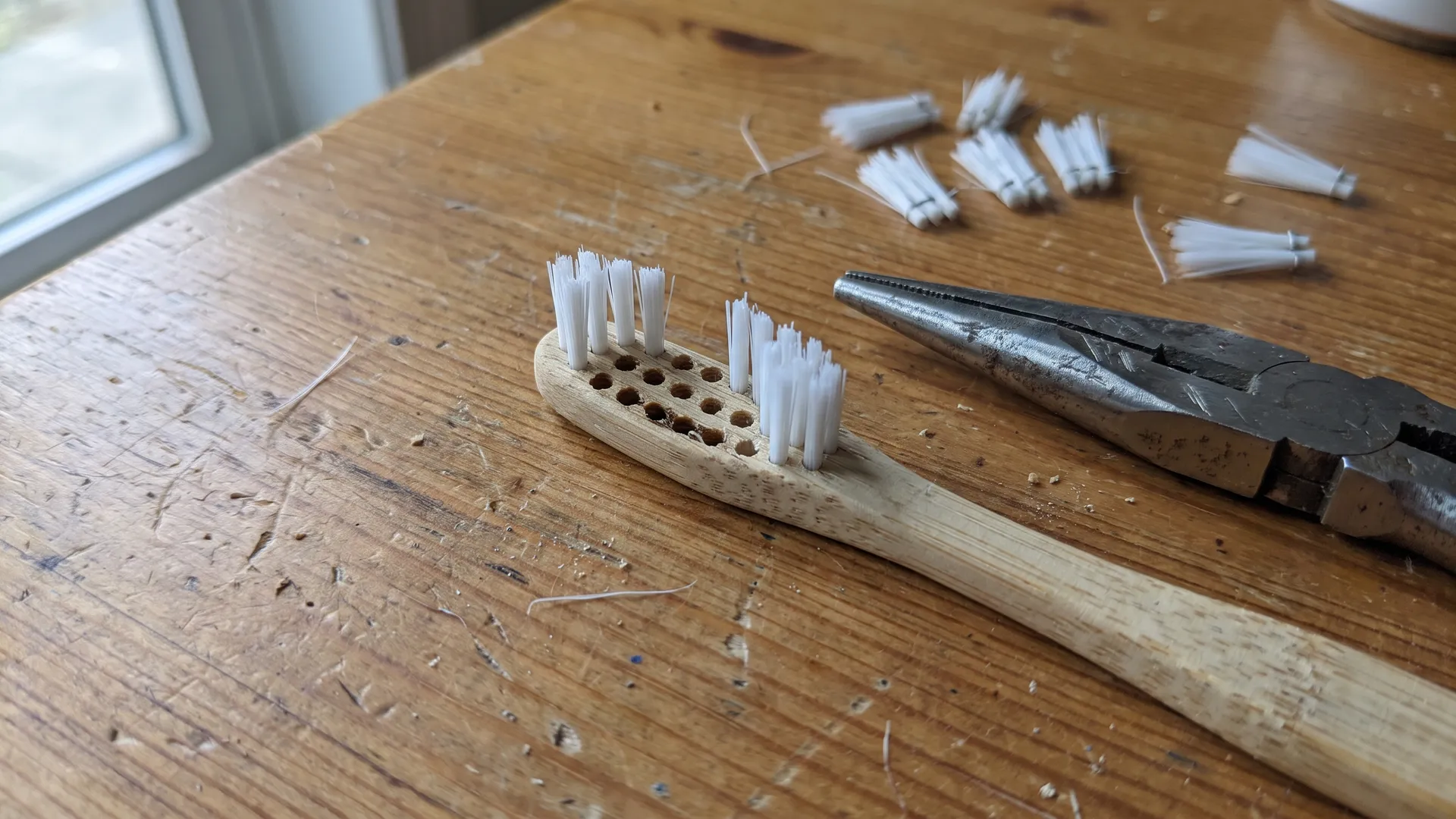
How a stapled toothbrush is made
Toothbrush patents describe the same method again and again. The head is moulded or drilled with a row of small holes. Each tuft of bristles is folded in half into a U, and a small plate-like staple drives it into a hole. The staple is slightly wider than the hole, so its edges cut into the sides and friction holds it there. One patent calls this the conventional manufacturing process; a German patent filed in 1988 described it as the market-dominant way toothbrushes were made. We couldn’t find current figures on how many brushes are still made this way.
What the staples are made of
Usually metal, in the patents we read; one describes a plastic alternative (below). A patent filed in 2009 said toothbrush staples are typically a nickel-silver alloy, and that makers had long wanted a cheaper metal such as brass. A patent filed in 2011 describes known staples as metals and alloys containing nickel, copper, zinc and/or silver.
Brushes without staples
There are other ways to hold bristles in. In anchor-free tufting, the tufts aren’t folded; their ends sit in the holes and are fastened, for example, by welding or adhesive bonding. In hot tufting, the tuft ends are held in a mould, sometimes melted into a ball, and the head is moulded around them. One toothbrush machine maker describes a process that thermally bonds the bristles straight onto the head, so the whole brush can be one type of plastic. And the patent filed in 2011 describes a plastic staple as an alternative to metal, partly so the staple could be recyclable.
Glue has its own history: a 1992 patent on small applicator brushes said gluing tufts in had proven relatively costly, difficult and time consuming. We couldn’t find a source on how often glue is used in toothbrushes today.
Bamboo brushes too
A bamboo handle doesn’t mean a staple-free head. A 2023 patent application describes a toothbrush with a bamboo head where each tuft is secured in its hole by an anchor wire, which the application says may be a nickel alloy. On a stapled bamboo brush you can see it at the end of its life: pull a tuft out with pliers and the staple usually comes with it. Most bamboo brushes also have nylon bristles, which is the bigger reason the head can’t go in the compost.
What staples mean when the brush is done
For recycling, the Australian Dental Association says most toothbrushes can’t go in the home recycling bin. In brushmaking more broadly, a 1992 patent noted that a metal staple in an otherwise all-plastic brush can present a recycling problem.
For composting a bamboo handle, the staples have to come out with the bristles. Metal doesn’t compost. Commercial compost made to the Australian standard AS 4454 is also tested for pieces of glass, metal and rigid plastic over 2 mm, with a limit. The simplest route is the one Maroondah City Council in Victoria gives: break the head off into the general waste bin and compost the handle. Council rules differ, though: in NSW, FOGO bins take only food, garden organics and approved caddy liners, so check your own council’s guide (as at October 2026). Our step-by-step for pulling tufts is in how to dispose of a bamboo toothbrush.
Where we fit
Our bristles are sterilised horse hair woven into the bamboo head, with no glue and no nylon. There is one small aluminium staple inside the head. Aluminium doesn’t compost, so when the rest has broken down, fish the staple out and put it in the general waste bin. We’d rather say that here than round it up; more on that in our guide to compostable toothbrushes.
The short version
- The conventional method fixes each tuft with a tiny staple, usually metal.
- Some brushes weld, glue or mould the tufts in instead; plastic staples have been patented too.
- Bamboo brushes can be stapled just like plastic ones.
- Staples don’t compost: take them out with the bristles, or break the head off.
Common questions
01Do toothbrushes have metal staples?
Often, yes. The conventional way to fix bristles, described in toothbrush patents, is to fold each tuft into a U and drive it into a hole in the head with a tiny metal staple, one per tuft. Not every brush works this way: some have the tuft ends welded, glued or melted and moulded into the head instead, and plastic staples have been patented too. We couldn't find current figures on how many brushes use each method.
02What metal are toothbrush staples made of?
Patents describe toothbrush staples made from nickel silver, brass, and other alloys containing nickel, copper, zinc or silver. A patent filed in 2009 called nickel silver typical. If the pack doesn't say, the maker may be able to tell you.
03Do bamboo toothbrushes have staples?
They can. A bamboo head can be stapled the same way as a plastic one; a 2023 patent application describes a bamboo-headed toothbrush with each tuft secured by an anchor wire, which it says may be a nickel alloy. If you pull the tufts from a stapled bamboo brush with pliers, the staple usually comes out with each one.
04Can you compost a toothbrush with staples in it?
Not the staples. Metal doesn't compost. Remove the bristles and their staples, or break the head off, before composting a bamboo handle, and check whether your council takes bamboo handles at all: some do, while NSW FOGO bins take only food, garden organics and approved caddy liners (as at October 2026).
Sources
- Toothbrush having improved tuft retention and anchor wire (US 8,402,591 B2). United States patent, via Google Patents, 2013. Checked .
- Verfahren und Vorrichtung zum Herstellen von Bürsten (DE 38 32 520 A1). German patent application, via Google Patents, 1990. Checked .
- Oral cleaning implement having a plastic staple comprising a cavity (US 9,119,462 B2). United States patent, via Google Patents, 2015. Checked .
- Toothbrush head with anchor-free bristle tufting (US 6,957,468 B2). United States patent, via Google Patents, 2005. Checked .
- Manual toothbrush (US 12,226,008 B2). United States patent, via Google Patents, 2025. Checked .
- ZAHORANSKY EDGE: High-Tech, Design Freedom, and Sustainability in Toothbrush Manufacturing. ZAHORANSKY, 2025. Checked .
- Toothbrush and Anchor Wire Therefor (US 2023/0210247 A1). United States patent application, via Google Patents, 2023. Checked .
- Exploring Sustainable Alternatives for Toothbrushes. Plastics Engineering (Society of Plastics Engineers), 2024. Checked .
- Brush construction (US 5,159,736 A). United States patent, via Google Patents, 1992. Checked .
- Sustainable oral health care. Australian Dental Association. Checked .
- AS 4454:2012 example compost analysis report. Environmental Analysis Laboratory, Southern Cross University. Checked .
- Toothbrush (bamboo): A to Z of waste disposal guide. Maroondah City Council. Checked .
- What can and can't go in your FOGO bin. NSW Environment Protection Authority. Checked .
Sources were checked between 3 and 9 October 2026: toothbrush and brush patents filed from 1988 to 2020, a toothbrush machine maker, Australian council and compost-standard documents, and the Australian Dental Association. Council rules change, so check your own.