What are toothbrushes made of?
An ordinary toothbrush is four materials: a polypropylene handle, a rubbery thermoplastic grip, nylon bristles, and a tiny metal staple holding each tuft in. Everything but the staples is plastic. It wasn’t always so — bristles were animal hair for over four centuries, until nylon arrived in 1938.
Written by Reuben S., who runs BARE and packs every order. Published 18 August 2026
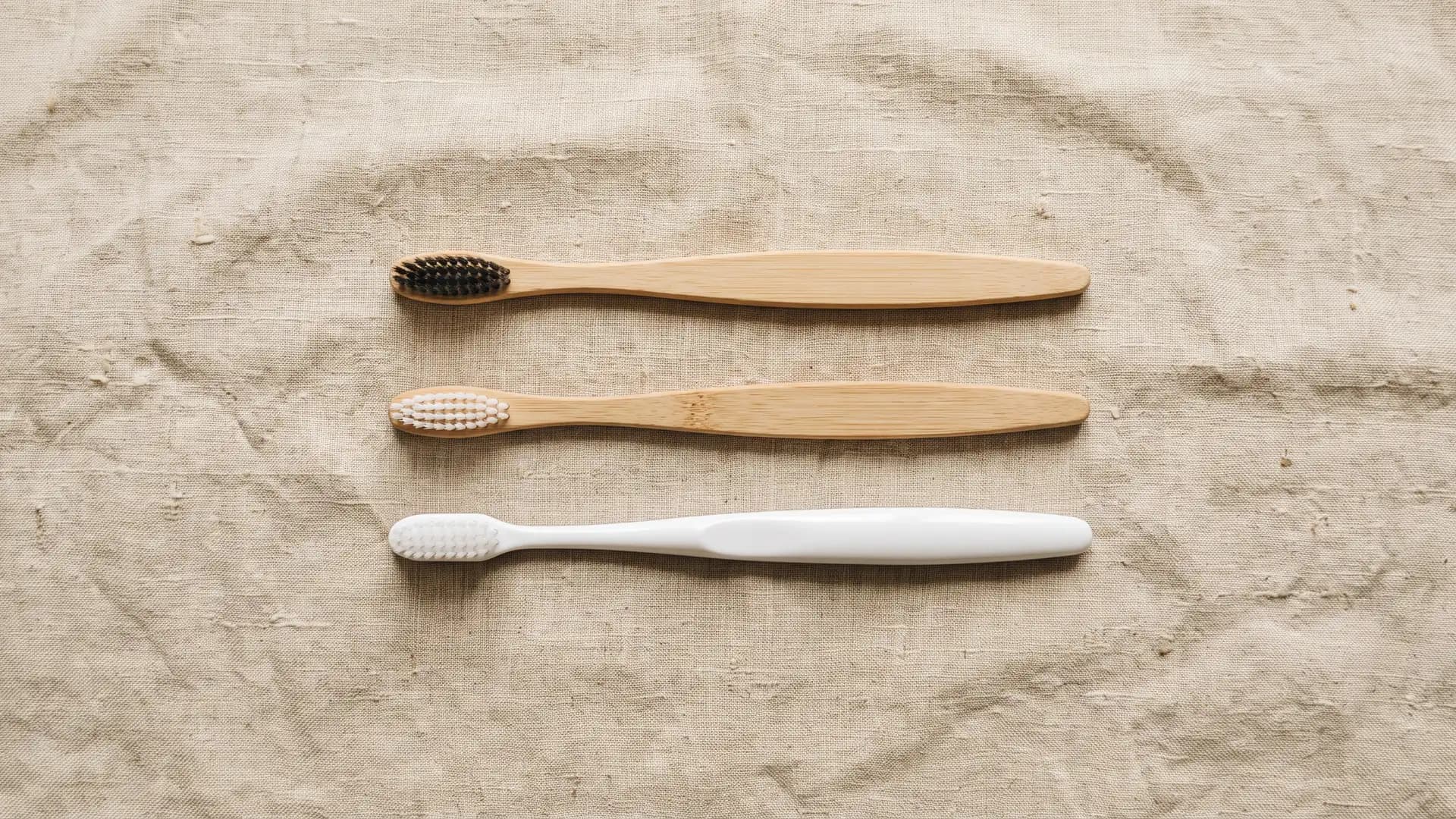
The four materials in an ordinary brush
| Part | Material | What it is |
|---|---|---|
| Handle | Polypropylene (PP) | A hard commodity plastic — the same family as yoghurt tubs and bottle caps |
| Grip zones | Thermoplastic elastomer (TPE) | The soft, rubbery panels moulded over the handle — also a plastic |
| Bristles | Nylon (polyamide), sometimes PBT polyester | A synthetic fibre and the most widely used bristle material, bamboo brushes included |
| Tuft anchors | Small metal staples | One per tuft, clamped into a drilled socket — the only non-plastic part |
That mix is the whole reason a worn-out brush is such an awkward object: too small and too mixed-material to recycle kerbside, and the materials involved are ones a landfill keeps essentially forever — fragmenting rather than decomposing. If the safety of those plastics is your question, that has its own honest page — the short answer is that the scare is mostly misdirected.
What a bamboo toothbrush is made of
Usually: a bamboo handle, the same nylon bristles, and the same metal staples. The handle genuinely improves — bamboo composts where polypropylene persists — but the bristle bed stays plastic in almost every bamboo brush sold, which is the part most buyers never learn. A small minority of brushes, ours among them, use natural bristles instead — keratin fibre from boar or horse — which is the only way a bristle bed avoids plastic entirely today. The full material recipes are compared in the bamboo-vs-plastic guide.
When did toothbrushes become plastic?
In two steps, both in the first half of the 1900s. Handles went first: bone and wood gave way to celluloid and the other early plastics of the early twentieth century, which were cheaper to shape and didn’t rot in a wet bathroom. The bristles held out longer — boar bristle had been the standard since the bristle toothbrush emerged in China around 1498, with horse hair as the softer option.
The decisive year was 1938, when nylon — newly invented — replaced animal bristle, and the first nylon-bristle brushes went on sale in the United States. Nylon was cheap, uniform, quick-drying and easy to manufacture, and it deserved to win on those terms. Within a couple of decades the all-plastic toothbrush was simply what a toothbrush was, and four centuries of natural bristle became a curiosity. What nobody weighed in 1938 was the other property plastic brought: every brush made since is, in material terms, still somewhere.
Where each material ends up
The handle and grip go to landfill and stay there — recycling is a mail-back program, not a kerbside bin. The nylon bristles go to landfill too, minus the fragments worn tips shed along the way. Scaled by the number of brushes Australia discards a year — we’ve published our estimate with the working shown — the material choice in this one small object adds up. A bamboo handle composts; natural bristles compost; and the honest limit of even that recipe is a small staple that doesn’t.
The short version
- Ordinary brush: polypropylene handle, TPE grip, nylon bristles, metal staples — all plastic except the staples.
- Bamboo brushes usually change only the handle; the bristles stay nylon.
- Bristles were boar or horse hair for over 400 years; nylon took over in 1938.
- None of it is kerbside-recyclable in Australia; the plastic parts persist, the natural parts compost.
- The only non-plastic bristle today is natural hair — the choice we built our brush around.
Common questions
01What are toothbrushes made of?
An ordinary manual toothbrush is a polypropylene handle, usually with a softer rubbery grip zone (a thermoplastic elastomer), nylon bristles, and a tiny metal staple anchoring each tuft of bristles into the head. Apart from those staples, every part is a plastic. Bamboo brushes swap the handle for bamboo but almost always keep the nylon bristles and metal staples.
02When did toothbrushes become plastic?
In stages across the first half of the 1900s. Handles moved from bone and wood to celluloid and other early plastics in the early twentieth century, and the decisive moment came in 1938, when nylon bristles replaced boar bristle — the first nylon-bristle brushes went on sale in the United States that year. Within a couple of decades the all-plastic brush was simply what a toothbrush was.
03What were toothbrushes made of before plastic?
Animal fibre and whatever made a good handle. The bristle toothbrush dates to China around 1498 — coarse hog bristle set into bone or bamboo — and boar bristle remained the standard for over four centuries, with horse hair used where something softer was wanted. Before bristle brushes, many cultures cleaned teeth with chewing sticks such as miswak.
04Are toothbrush bristles plastic?
Almost always. Nylon, a plastic, is the most widely used bristle material, and it is the most common choice on bamboo brushes too: a bamboo handle says nothing about the bristles. The exceptions are natural-bristle brushes using boar bristle or horse hair, which are keratin, an animal protein fibre.
05What part of a toothbrush is recyclable?
In practice, none of it through an Australian kerbside bin — a toothbrush is too small and too mixed-material for council sorting, whatever the plastics technically are. Free mail-back programs accept oral-care waste instead. A bamboo handle sidesteps the problem by composting, once the bristles are dealt with.
Nothing here is dental advice. For anything about your own teeth or gums, ask your dentist or oral health therapist.