Horse hair toothbrush bristles, explained
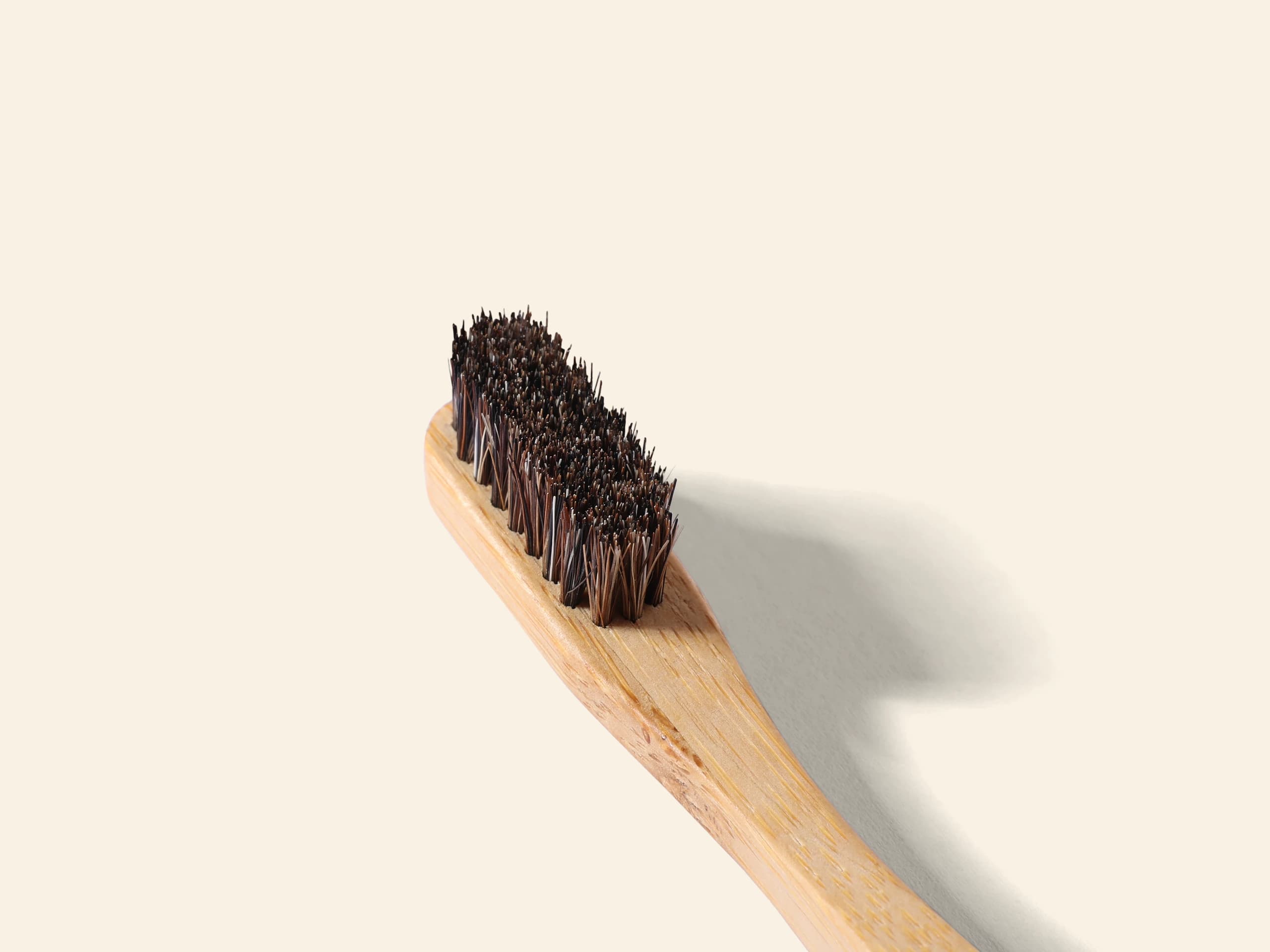
Horse hair bristles are made from horse tail or mane hair instead of nylon. Because the hair is keratin — the same protein family as wool — it isn’t a plastic, and it breaks down in compost the way other animal fibres do. Each strand is finer than an extruded nylon filament and tapers naturally to a point rather than being cut flat, so the brush feels softer. The trade-offs: it takes longer to dry, and it isn’t vegan.
Written by Reuben S., who runs BARE and packs every order. Published 11 August 2026 · Last fact-checked 19 August 2026
Nylon is the newcomer, not the default
It’s easy to assume plastic bristles are simply what a toothbrush is. They aren’t. The bristle toothbrush was invented in China in 1498, using coarse hog hair set into handles of bone or bamboo, and natural animal bristle stayed the standard material for well over four hundred years.
Nylon arrived in 1938, when DuPont’s new synthetic fibre went into a brush sold as Doctor West’s Miracle Tuft. It was cheaper, it dried faster, and it was consistent in a way that an animal product never is. Within a generation it had replaced natural bristle almost entirely.
That switch was never really a decision anyone made about their own mouth. It was a manufacturing decision, and it happened to arrive decades before anyone was thinking about what a few billion small pieces of permanent plastic a year would add up to.
What “softer” actually means
Nylon bristles are extruded: liquid polymer is pushed through a die, producing filaments of identical thickness, then cut to length. The cut leaves a blunt flat end, which is why better brushes put them through a separate rounding process afterwards.
A hair grows instead of being extruded, so it is naturally finer along its length and comes to a point at the tip without anything being done to it. It is also less uniform: strands vary in thickness and stiffness within the same tuft, which is why a natural-bristle head looks slightly irregular up close.
What you feel is the result of those two things — finer, more flexible strands that give more readily against the teeth. It is a real difference in feel, and people switching from nylon usually notice it immediately.
What it isn’t is a substitute for technique. How you brush matters more than what you brush with, and no bristle material changes that. If you want advice about your own teeth, that’s a question for your dentist, not a toothbrush company.
Looking after one
Natural fibre holds water longer than nylon, so drying is the one habit that actually matters. None of this is difficult, but it is a slightly different routine.
- Rinse the head thoroughly under running water after brushing, working the water through the bristles rather than just wetting the surface.
- Flick the water out, then stand the brush upright with the head in open air. Standing it head-down in a closed cup, or shutting it in a travel case while damp, is what causes problems.
- Give it somewhere with a little airflow. A bathroom shelf is fine; a sealed drawer is not.
- Expect a few loose bristles in the first week. In a glue-free head the tufts bed in as you use them, and a strand or two working free early on is normal.
At the end of its life
This is where natural bristle genuinely differs. Keratin is a protein fibre, so the bristles break down in a compost heap much as wool or hair would, rather than persisting the way nylon does. There is no need to pull the tufts out with pliers before the handle can be composted — which is exactly the job a standard bamboo brush requires, and which we wrote about in detail in how to dispose of a bamboo toothbrush in Australia.
Bamboo handles are woody and slow, so give the whole thing months rather than weeks, and expect it to take longer in a cold or dry heap. Breaking the handle into a few pieces first helps.
Where it doesn’t suit
Three honest limits, because you should know them before you buy rather than after.
It isn’t vegan. Horse hair is an animal product. However it is collected — ours comes from routine grooming, gently, with no animal harmed — that fact doesn’t change, and anyone avoiding animal products entirely should buy something else. We would rather say that plainly than let a “natural” label do the work of implying otherwise.
It takes longer to dry. If your brush lives in a sealed travel case, or in a windowless ensuite where nothing ever quite dries out, nylon will be less trouble.
It is not uniform. Every head is slightly different, because hair is. If you want a product that is identical to the last one every single time, that is a genuine argument for the synthetic.
The short version
- Natural bristle was standard for 440 years; nylon replaced it in 1938.
- Horse hair is keratin, not plastic — it is finer and more flexible than nylon, and it composts.
- Rinse it, stand it upright, let it dry in open air. That is the whole maintenance routine.
- Not vegan, slower to dry, never quite identical.
Common questions
01What are horse hair toothbrush bristles?
Bristles made from horse hair — usually tail or mane hair — rather than nylon. Horse hair is keratin, the same protein family as human hair and wool, so unlike nylon it is not a plastic and it breaks down the way other animal fibres do. Natural bristle was the standard material for toothbrushes for centuries before nylon replaced it in 1938.
02Are horse hair bristles softer than nylon?
Individual horse hairs are finer and more flexible than the extruded nylon filaments used in most toothbrushes, and each one tapers naturally to a point rather than being cut flat. In practice that means the brush feels softer and more yielding. How hard you press and how you brush still matter far more than what the bristles are made of.
03Are horse hair toothbrushes hygienic?
Yes, with normal care. Natural fibre holds water longer than nylon does, so the important habit is rinsing the head thoroughly and letting it dry standing upright in open air rather than sealed in a case or a closed cupboard. A brush that dries properly between uses stays clean and odourless.
04How is a horse hair toothbrush different from a boar bristle one?
Both are natural animal fibre and both compost, but boar bristle is noticeably coarser and stiffer. Boar was the traditional material from the fifteenth century onwards. Horse hair is finer and more flexible, which most people find more comfortable in the mouth.
05Is a horse hair toothbrush vegan?
No. Horse hair is an animal product, so a brush using it is not vegan regardless of how it is collected. Anyone who avoids animal products entirely should choose a plant-based or synthetic alternative instead.
Nothing here is dental advice. For anything about your own teeth or gums, ask your dentist or oral health therapist.