Are sugarcane toothbrushes biodegradable?
Not if the handle is sugarcane-based polyethylene. That plastic is made from sugarcane ethanol but is chemically identical to ordinary polyethylene, and it isn’t biodegradable. “Sugarcane” tells you where some of the raw material came from, not what happens to the handle at the end. Sugarcane fibre, called bagasse, is a different material.
Written by Reuben S., who runs BARE and packs every order. Published 9 October 2026
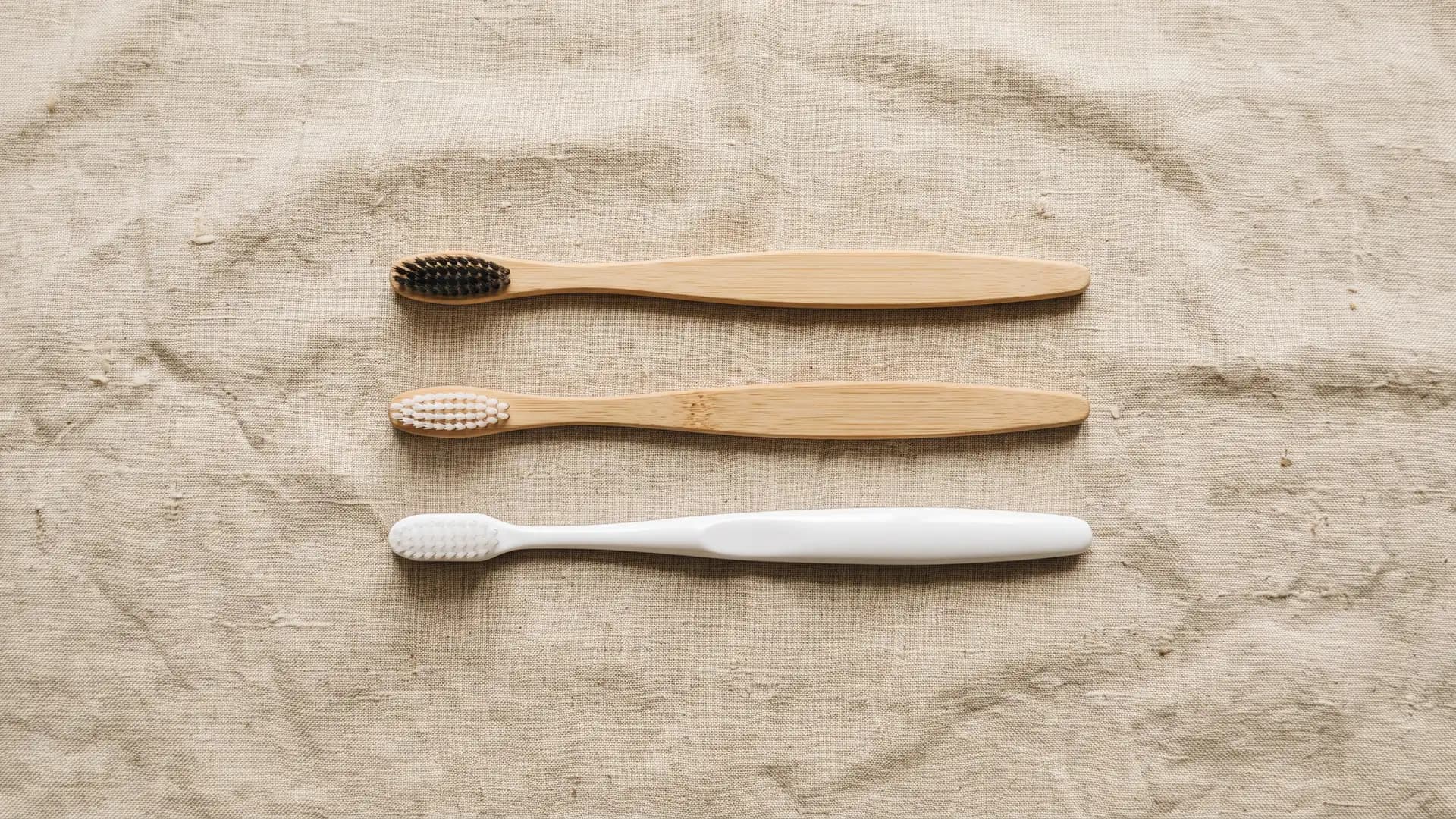
How sugarcane becomes plastic
Sugarcane juice is fermented into ethanol, the ethanol is turned into ethylene, and the ethylene is polymerised into polyethylene. A 2020 review describes the result as identical to fossil-based polyethylene in its chemical, physical and mechanical properties. One producer agrees: its bio-based plastics are chemically identical to their fossil fuel counterparts. It isn’t necessarily all plant carbon: the producer says the renewable carbon content of most grades ranges from at least 84% to at least 96%.
Is it biodegradable?
No. The same review puts it simply: “Of course, bio-PE is not biodegradable.” Whether a plastic biodegrades depends on its chemical structure, not on where its raw materials came from, and even Europe’s bioplastics industry association lists bio-based polyethylene among bio-based, non-biodegradable plastics. Polyethylene itself is one of the plastics most resistant to biodegradation; complete biodegradation of it has not been achieved. UN Environment notes that the word “bioplastic” can lead people to assume a product is completely plant-based or biodegradable.
Australia’s consumer regulator has used a case very like this as a warning. The ACCC’s guide to environmental claims describes a toothbrush made from bio-based polyethylene, labelled “biodegradable approved” without testing, and counts that label as a claim likely to be false or misleading, because that plastic is not biodegradable. It’s a hypothetical example, but a pointed one.
Sugarcane plastic vs sugarcane fibre
Part of the confusion is that “sugarcane” covers two very different things. Bagasse is the fibre left over from sugarcane, used to make packaging and food service ware as an alternative to plastic. The NSW EPA lists “plant-based (e.g. made from sugarcane…)” as a marketing term that doesn’t change whether an item is plastic, while suggesting vegetable fibre, including bagasse, as an alternative. Its definition of plastic covers polymers from plant extracts or fossil fuels, lists polyethylene as plastic, and lists bagasse as not plastic.
Bin rules for compostable sugarcane items differ (as at October 2026). South Australia takes certified compostable takeaway items, including sugarcane products, in the green bin. The ACT says bagasse products go in general waste, not the FOGO bin, because they need industrial composting; items with the AS 5810 home compostable logo can go in a home compost.
The carbon claim
The case for sugarcane plastic is about carbon, not about the bin. One producer reports a footprint of -2.12 kg of CO2 equivalent per kilogram from its own life-cycle study, which runs from cradle to factory gate, so it leaves out what happens to the product afterwards. A peer-reviewed 2012 study found land-use change decisive for the climate result: in the worst case it made sugarcane polyethylene comparable to the fossil kind.
Can it be recycled?
One producer says its plastic is recyclable within existing streams for ordinary plastics. That applies to the material, not to a toothbrush: the Australian Dental Association says most toothbrushes can’t go in the home recycling bin. We cover the options in can you recycle a plastic toothbrush?
What to check on the label
- What the handle is made of. “Sugarcane” or “plant-based” doesn’t name the material. It could be polyethylene, or another plastic altogether (see PLA).
- “Biodegradable”. The ACCC says a product may only break down in certain conditions or after a very long time, and leaving that out can mislead. Ask which standard and which conditions.
- The bristles. A plant-based handle says nothing about them, and nylon is the most widely used bristle material.
Where we fit
Our handle is bamboo and our bristles are sterilised horse hair woven into the head, with no nylon and no glue. There is one small aluminium staple inside the head that doesn’t compost, so fish it out at the end. More on what breaks down and what doesn’t in our guide to compostable toothbrushes.
The short version
- Sugarcane polyethylene is chemically identical to ordinary polyethylene.
- It isn’t biodegradable, and polyethylene is among the plastics most resistant to biodegradation.
- Sugarcane fibre (bagasse) is a different material; a polyethylene handle isn’t bagasse.
- The carbon benefit is a producer’s factory-gate figure and depends on land use.
Common questions
01Are sugarcane toothbrushes biodegradable?
Not if the handle is sugarcane-based polyethylene. That plastic is made from sugarcane ethanol but is chemically identical to ordinary polyethylene, and a peer-reviewed review states plainly that it is not biodegradable. The ACCC's guide to environmental claims uses a hypothetical bio-based polyethylene toothbrush, labelled 'biodegradable approved' without testing, as an example of a claim likely to be false or misleading. Check what the handle is actually made of.
02Is sugarcane plastic the same as normal plastic?
Chemically, yes, if it's sugarcane polyethylene. Sugarcane juice is fermented to ethanol, turned into ethylene and polymerised, and the result is identical to polyethylene made from oil, including in recycling. The difference is where its raw material came from, and it isn't necessarily all plant carbon: one producer says the renewable carbon content of most grades ranges from at least 84% to at least 96%.
03Can you compost a sugarcane toothbrush?
Not if the handle is sugarcane polyethylene, which isn't biodegradable. Sugarcane fibre, called bagasse, is a different material used for packaging and food service ware. Rules for compostable sugarcane items vary (as at October 2026): South Australia takes certified compostable takeaway items, including sugarcane products, in the green bin, while the ACT sends bagasse products to general waste. A polyethylene handle isn't one of those items.
04Are sugarcane toothbrushes better for the environment?
Possibly for carbon, not for end of life. A producer of sugarcane polyethylene reports a negative carbon footprint, from its own study that stops at the factory gate, and a peer-reviewed 2012 study found the climate benefit depends on land-use change. At the end of its life the handle behaves like any polyethylene, which is among the plastics most resistant to biodegradation.
Sources
- Bio-Polyethylene (Bio-PE), Bio-Polypropylene (Bio-PP) and Bio-Poly(ethylene terephthalate) (Bio-PET): Recent Developments in Bio-Based Polymers Analogous to Petroleum-Derived Ones for Packaging and Engineering Applications. Polymers, 2020. DOI 10.3390/polym12081641. Checked .
- My environmental impact (I'm green bio-based). Braskem. Checked .
- I'm green bio-based (brochure). Braskem (hosted by its distributor FKuR), 2025. Checked .
- What are bioplastics? Material types, terminology, and labels. European Bioplastics, 2022. Checked .
- Challenges with Verifying Microbial Degradation of Polyethylene. Polymers, 2020. DOI 10.3390/polym12010123. Checked .
- Making environmental claims: a guide for business. Australian Competition and Consumer Commission, 2023. Checked .
- Plastic bans: Bioplastics (fact sheet). NSW Environment Protection Authority, 2026. Checked .
- Plastics definition for suppliers. NSW Environment Protection Authority, 2024. Checked .
- Could your takeaway container be composted?. Green Industries SA. Checked .
- Bagasse and sugarcane pulp products (Recyclopaedia). ACT Government, City Services. Checked .
- Bioplastics (LEAP glossary). UN Environment Programme, Law and Environment Assistance Platform. Checked .
- LCA and carbon footprint (I'm green bio-based). Braskem. Checked .
- A Comparative Life Cycle Assessment Study of Polyethylene Based on Sugarcane and Crude Oil. Journal of Industrial Ecology, 2012. DOI 10.1111/j.1530-9290.2011.00405.x. Checked .
- Sustainable oral health care. Australian Dental Association. Checked .
- Physicochemical Properties of Curen Filaments Versus Nylon Filaments in Toothbrush Bristles: An In Vitro Study. Cureus, 2024. DOI 10.7759/cureus.75767. Checked .
Sources were checked between 3 and 9 October 2026: the ACCC, the NSW EPA, the ACT and SA governments, UN Environment, the Australian Dental Association, peer-reviewed research, the bioplastics industry association and the plastic’s producer. Products vary, so check the specific brush.